
اقرأ المقالة باللغة العربية هنا

   I am often confronted by the question “Are you Iranian or Persian, and what’s the difference?” and it has become something of a bonding ritual among Iranians I know to discuss the various ways in which we answer that question. For many years, I answered that there existed little difference between the two besides a political connotation, “Persian” being the adjective of choice for those who avoided any connection to the Islamic Republic. Noted Iranian comedian Maz Jobrani, similarly, points to the historically alluring and exotic sound of “Persian,” as well as its connection to [Persian] cats and rugs, in order to explain why many people prefer to use this word instead of “Iranian.” 

   This worked pretty well for me until the day I met a young Iranian-American of mixed Azeri-Bakhtiari Iranian heritage. While flippantly describing us jointly as “Persian,” I was pointedly informed that besides the language she spoke and a mainstream Iranian culture we shared, there was not much “Persian” about her. I had been describing myself and other Iranian-Americans I knew as Persian not merely because it was convenient, but in fact because we were Iranians of Persian ethnicity. And this was the day I found out that Iran is not, in fact, a wholly “Persian” country, contrary to popular belief and the continued insistence of many Iranians.

   In fact, Persians- here defined as those whose mother tongue is Persian and identify themselves as such- make up about half (though some estimates range as high as 60%), the rest being composed of Azeris, Arabs, Balochis, Kurds, Gilanis, Mazanderanis, Loris, Qashqais, Bakhtiaris, Armenians and a whole host of other ethnic groups who collectively identify as Iranians and speak the Persian language but but whose ethnic identity is other than Persian. In addition to these ethnic and linguistic minorities, there exists a host of religious minorities- Sunni Muslims, Christians, Jews, Bahais, Zoroastrians, etc- who also fit across the ethnic mosaic described above, some identifying as Persians and others not.

   On some level, I had always known Iran was not a “Persian” country. I grew up hearing jokes about “Turks”– meaning Iranians of Azeri extraction, sometimes called “Azeri Turks” because of their cultural and linguistic affinities to Turkey- and noticed that I could not always understand languages I heard spoken on Tehran streets. And yet, despite this, every journalist and every Iranian I knew insisted Iranians were Persians, in the process denying the existence of half of Iran’s population.

   The injustice and absurdity of this denial finds its roots not just in ignorance but in the prevalent and virulent brand Persian racism rooted in mid-20th century Iranian nationalism that sought to wipe out our country’s ethnic diversity.The development of nation states around the world over the last two centuries has been accompanied by violent attempts to overlook or erase national diversity within the boundaries of the state. The natural diversity of human culture has been manipulated and condemned by state leaders and by politicians seeking re-election, narrowing the limits of belonging and attempting to draw lines to distinguish those who are a part of “us” and those who are “not.”

   In countries like France this process has involved the development of a school system that brutally forced children with linguistic and cultural backgrounds other than proper [Parisian] French to assimilate and forget their languages or dialects; often, this was achieved by beating students who spoke their mother tongue at school and teaching them that it was worthless (history of French linguistic nationalism here). In places like Germany, meanwhile, territorial expansion into areas inhabited by German-speakers combined with physical extermination was used to rid the nation of religious minorities (like Jews and Catholics) and cultural minorities (like the Roma and Sinti) who seemed impossible to assimilate while uniting geographically disparate ethnic German communities (overview of those policies here).

   The creation of nation states outside of Europe, a process facilitated through both colonialism as well as resistance to it, spread the development of exclusivist national projects globally. Iran has been no stranger to this process; indeed, the development of an Iranian national identity, under both the Pahlavi regime and the Islamic Republic, has involved controlling and marginalizing those who do not fit correctly within the normative construction of what it is to be “Iranian.”

   The Pahlavi regime’s definition of Iranianness finds its roots in the construction of an exclusivist Iranian identity in the 1920’s and 30’s. The increasingly centralized and authoritarian state of Reza Shah Pahlavi sought to eliminate linguistic and cultural diversity by crafting a narrative of Persian Iranian history that went back nearly 2500 years that was united by the determination of the Persian people. This was of course an artificial history, just as nationalisms always are- both the Qajar and Safavid dynasties preceding the Pahlavi were Azeri Turkish, for example, and historically it was not ethnicity but ethnically neutral imperialism and the use of Persian language as a lingua franca that had brought together the incredibly diverse peoples populating the lands under control of the “Persian Empire.” 

   Reza Shah took his cue from the nationalist ideological currents sweeping Europe and Turkey, where colonial scholarship had long equated language with ethnicity as part of the efforts to understand the success of certain nation-states as compared to others. Aryanism was one of the most influential of these ideologies, and it identified the Indo-European language tree (which includes Sanskrit, Persian, and most European languages) as proof of a migration of an imagined Aryan nation out of India, through Persia, and into Europe. Aryanism was highly convenient for Europeans because it made sense of the Indian and Persian civilizations they were encountering through their colonial enterprises.

   According to this theory, Europe represented the pinnacle of the racial hierarchy while Indian and Persian civilizations were mere steps on the way to contemporary greatness. Additionally, it distanced Europeans from the Semitic languages of the Jews and Arabs, offering a pseudo-scientific rationale for both racialist anti-Semitism and Orientalism.

   Pleased to be offered a position just below his European masters on the ladder of civilizations, Reza Shah declared Iran a nation of “Aryans.” He subsequently banned the use of languages other than Persian in schools and written media more broadly. We all became Persian, and other languages became mere dialects not suitable for official use (especially non-Indo European tongues like Azeri Turkish and Semitic Arabic, but also Indo-European Kurdish).

   On one hand, this form of nationalism allowed religious minorities that consider themselves Persians- like most Jews, Bahais, and atheists- to be a part of normative Iranianness, because being Iranian was defined by how Persian you are and thus offered a secular national identity for those 10% of Iranians who were not Shia to be a part of. On the other hand, however, this came at the expense of the 49% of Iranians who now had to either lose their heritage or exist silently at the margins.

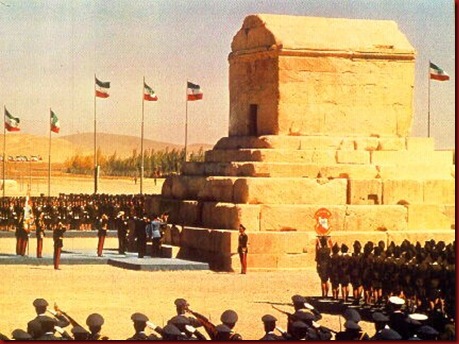
Mohammad Reza Shah Pahlavi at the tomb of Cyrus the Great, a 2500-year old emperor known for his commitment to human rights who probably would not have liked the Shah, a tyrant known for a CIA-trained secret police.    Mohammad Reza Shah Pahlavi at the tomb of Cyrus the Great, a 2500-year old emperor known for his commitment to human rights
who probably would not have liked the Shah, a tyrant known for a CIA-trained secret police.

   Although his co-option of ancient Persian and Zoroastrian symbols in order to describe his rule was anachronistic and repulsive to some Iranians- many of whom scoffed at his references to Cyrus the Great and divine rule by using terms like, “universal ruler,” Shahanshah (“King of Kings”), and Aryamehr, (“light of the Aryans”) to describe himself- most Iranians eventually bought these racialist myths of Iranian-ness and the narrative became naturalized.

   Even today it’s not uncommon to hear Iranians describe themselves as Aryans, usually when emphasizing their non-Arabness to white people and linking themselves to Europe (“Really, we are Aryans, our language is more similar to German than Arabic!”). Of course, these attempts are often received with awkward horror, the term “Aryan” having fallen out of usage following Adolf Hitler’s unfortunate decision to wholeheartedly adopt the Aryan theory as a rationale for genocide. 

   The Islamic Revolution of 1979 dramatically shifted these meanings of Iranianness. Secular Persianness was replaced with religious Shianess; in the course of just a few years, the official way to be Iranian was by being an observant Shia Muslim and thus lost a great deal of its association with ethnic Persianness.

   In contrast to Pahlavi Iranianness which excluded non-Persians, under the Islamic Republic all Shia Muslims regardless of ethnicity could be normative Iranian citizens, meaning that 90% of Iranians could potentially fit the new Iranian national identity. 

   However, religious minorities- including those who considered themselves Persian, like most Jews and Bahais- were no longer part of mainstream Iranianness, and secular or non-observant people of Shia Muslim background found themselves marginalized as well.

   The Islamic Republic dealt with these in different ways: while seculars were to be forcibly assimilated as much as possible, Jews (and other non-Persian religious minorities, like Christians and Sunni Muslims) were to be respected as citizens with equal rights but slightly different status. 

   Languages other than Persian rapidly entered the public sphere and print use of other languages was legalized. Despite this, the ethno-supremacist version of Persian-Iranian nationalism did not disappear overnight; even as ethnic minorities like Mir Hossein Mousavi (Azeri), Mehdi Karroubi (Lori), and Ayatollah Khamenei (Azeri) reached top political and religious posts, the war against (mostly Arab) Iraq ensured the longevity of Persian nationalism in the face of a virulently anti-Persian foe.

   Persian ethnocentrism has remained an influential part of public discourse within Iran, and many Iranians outside of Iran as well cling to notions of Aryanism and Persianism deeply antithetical to an inclusive, egalitarian democratic future. In popular discourse these representations are rife, as the youtube videos above provide evidence of. Alireza Asgharzadeh’s book, “Iran and the Challenge of Diversity: Islamic Fundamentalism, Aryanist Racism, and Democratic Struggles,” tackles this discourse in depth, albeit with numerous methodological flaws (a shorter interview of his can be found here, while an extensive rebuttal to a number of his arguments and sources can be found here).

  The 2006 riots in Iranian Azerbaijan highlighted the persistence of this racist discourse- and its linguistic roots- in public discourse. In May of that year a satirical cartoon was published depicted a boy speaking to a cockroach in Persian as the cockroach responded “What?” in Azeri.

   An accompanying article pointed to the inability of cockroaches to understand reason and to the incomprehensibility and silliness of their own language, a provocation that led to riots across the majority-Azeri areas of Iran and left four dead. The cartoonist, an ethnic Azeri himself, was subsequently arrested and the newspaper shut down, but it can be surmised from the timing that the state’s reaction was to prevent more rioting, not tackle the prejudice at the heart of the issue.

   In our struggle as Iranians both in Iran and the diaspora to develop a national identity that is religiously inclusive, we must not simultaneously build one that is ethnically and linguistically exclusive. Crafting an inclusive national identity by recognizing the historical marginalization and silencing of Iran’s minority languages must be a crucial part of our national struggle for freedom and equality.

   Indeed, in a world full of exclusivist nation states and ethnic cleansings with the goal of “purifying” and homogenizing populations, Iran’s diversity stands out. We are a nation united not by ethnicity nor religion but by history and a shared, rich, diverse national culture.

  -- AJAM MEDIA COLLECTIVE

Sécheresse et changement climatique à Madagascar


Malnourished boy being examined in southern Madagascar

   Le sud enclin à la sécheresse de Madagascar est de nouveau aux prises avec une crise alimentaire cette année. La violence inhabituelle du phénomène El Niño se traduit par une absence de pluie. Les prix ont flambé sur les marchés locaux, laissant plus de 665 000 personnes dans un besoin urgent d'aide alimentaire.

   Cette immense île de l'océan Indien est l'un des pays du monde les plus exposés aux catastrophes naturelles. Les régions semi-arides de l'extrême sud de Madagascar - Androy, Anosy et Atsimo Andrefana - sont confrontées à de nouvelles crises chaque année. La manifestation récente du phénomène El Niño n'a fait qu'aggraver une situation déjà critique.

   Âgé de bientôt trois ans, Dami ne pèse pourtant que 6,9 kilos. Sous son short bleu et son t-shirt d'un blanc poussiéreux, ses membres ne sont guère plus épais qu'une carotte malgré un ventre gonflé : un signe inéluctable de malnutrition.

   Il suçote un sachet de Plumpy'Nut, un aliment prêt à l'emploi à haute valeur nutritionnelle à base d'arachide. Lorsque son sachet lui échappe et tombe à terre, sa sœur s'en empare aussitôt et se met à le mâcher. Elle aussi est affamée.

D'appétissants cactus

   La sécheresse qui sévit actuellement, l'une des pires à ce jour, a brûlé les cultures de riz et de manioc en laissant 80 pour cent de la population sans approvisionnement alimentaire sûr. De nombreuses communautés agricoles dépendent désormais de l'aide alimentaire - et des cactus.

« Cette sécheresse est la pire que j'aie jamais connue. L'année dernière, nous avons connu la sécheresse, mais il a un peu plu. Cette année en revanche, rien n'est tombé ou presque. »

   Le fruit rouge des cactus est utilisé comme denrée d'urgence dans le sud. Difficile à digérer, il peut toutefois provoquer des troubles intestinaux exacerbant les effets de la malnutrition. Dami est l'un des huit enfants d'Ambahinky Kazy, 38 ans, une mère pauvre peinant à trouver du travail. Elle souhaiterait que ses enfants deviennent instituteurs, mais aucun d'entre eux n'a été à l'école.

   Dami s'est vu remettre sa ration de Plumpy'Nut à la suite d'une opération de dépistage menée par UNICEF dans le village d'Ambondro, dans la région d'Androy. Lors de l'examen médical, son tour de bras n'était que de 10 centimètres - un chiffre alarmant.

   Jusqu'à 90 sachets de Plumpy'Nut sont nécessaires au rétablissement d'un enfant, mais le fait que les familles aient tendance à voir ce « médicament » comme de la nourriture, et à le partager entre les différents membres affamés de la fratrie, complique les choses.

   Depuis quatre ans, Mme Kazy a bénéficié du programme de l'UNICEF par intermittence avec ses différents enfants - un exemple tangible de la pauvreté chronique dont souffre la région.  

   Près d'un million d'enfants sont atteints de malnutrition aigüe à Madagascar, et cet État insulaire affiche l'un des taux les plus élevés au monde s'agissant du retard de croissance chez les enfants de moins de cinq ans.

   La crise de malnutrition est le principal enjeu de santé auquel le gouvernement doit faire face, d'après le ministre de la Santé Mamy Lalatiana Andriamanarivo. La situation « reste alarmante, en particulier dans le sud », a-t-il dit.

Une réponse insuffisante

   Le gouvernement dit faire de la lutte contre la crise alimentaire une priorité, mais ses efforts sont entravés par le manque de financements (une part importante du budget de la Santé est tributaire de l'aide étrangère) et des difficultés de mise en œuvre. La résilience des communautés vulnérables aux chocs climatiques n'a guère enregistré de progrès, et les infrastructures se délitent : chaque année, le nombre de routes perdues excède celui des routes construites.


   Cela s'explique en partie par les quatre ans de crise politique qu'a connus le pays, durant lesquels les pays donateurs ont gelé l'aide au développement - ce qui a  affecté « la capacité institutionnelle du gouvernement, la croissance économique et les efforts de développement social », a dit le Programme alimentaire mondial (PAM).

   L'insécurité alimentaire ne touche pas seulement les mères célibataires défavorisées et leurs enfants. Toute la communauté est affectée.

   « Je suis continuellement inquiet, tous les jours », a dit Damy Miarorala, le maire d'Ambondro. « Cette sécheresse est la pire que j'aie jamais connue. L'année dernière, nous avons connu la sécheresse, mais il a un peu plu. Cette année en revanche, rien n'est tombé ou presque. »

   La sécheresse de l'an passé a été meurtrière - en particulier chez les enfants - du fait de la malnutrition, et il semblerait que ce soit encore le cas cette année.

   « Ma principale inquiétude est qu'il y ait des décès dus au manque de nourriture. Certaines personnes s'alimentent du fruit rouge du cactus, ce qui est nuisible à leur santé », a dit M. Miarorala.

   Lorsqu'il lui a été demandé s'il avait faim, l'ami du maire, M. Malafeno, a ri en montrant ses habits trop larges pour lui. À l'époque où ils lui allaient encore, il pesait 90 kilos. Il en pèse aujourd'hui à peine 63.

Sous le radar

   Il est difficile pour Madagascar d'obtenir l'aide dont elle a besoin en raison de sa situation géographique « un peu perdue au milieu de l'océan », a expliqué Willem van Milink, le représentant du Programme alimentaire mondial dans le pays.

   Les travailleurs humanitaires estiment que Madagascar a été « rayée de la carte » et oubliée par la communauté internationale. Bien qu'écrasante et d'une gravité constante, la crise alimentaire malgache n'affiche pas les statistiques effroyables ou les événements catastrophiques donnant droit à une aide significative ou à l'attention des bailleurs de fonds en matière de développement.

   « Nous n'avons plus d'espoir. Nous attendons simplement de mourir. »

   Pourtant, la sécheresse est certainement le symptôme de l'un des enjeux mondiaux les plus urgents : le changement climatique.

   Cela fait cinq ans que les précipitations sont en deçà de leur niveau normal, d'après le chef Voasaotsy du village d'Anjampaly, dans le district de Tsihombe. En 2010, une averse de grêle a détruit leurs récoltes de maïs, de patate douce et de pastèque. La fertilité du sol en a pâti, et les cultures ne s'en sont pas remises depuis.

   « Nous n'avons plus rien à quoi nous raccrocher », a dit M. Voasaotsy. Mimant la manière dont les villageois s'alimentent en dehors de leur ration quotidienne de maïs assurée par le PAM, il a retiré les épines d'une feuille de cactus et a mordu dedans.

   Avec un désespoir flagrant, il a expliqué que les villageois avaient vendu leurs propriétés et leur bétail pour acheter la nourriture qu'ils avaient l'habitude de cultiver eux-mêmes. La moitié du village a migré en direction du nord. La moitié restante n'arrive pas à vendre ses terres, puisque tout le monde souhaite partir. Au moins cinq personnes sont mortes de faim.

   « Notre vie se résume à attendre qu'il pleuve », a continué M. Voasaotsy.  « Mais nous n'avons plus d'espoir. Nous attendons simplement de mourir. »


Will Worley -- IRIN News


27 octobre 2016

Dans le sud de Madagascar, les effets de la grave sécheresse provoquée par le phénomène El Niño sur la production agricole, où près de 850.000 personnes sont en situation de grave insécurité alimentaire, vont vraisemblablement se poursuivre jusqu'en 2017, a prévenu jeudi l'Organisation des Nations Unies pour l'alimentation et l'agriculture (FAO).


3 novembre 2016

Des pluies abondantes ont touchées la côte est de Madagascar, surtout Fort Dauphin. Mais le sud-ouest souffre encore de la sécheresse.

"77.000 osmanische Grundbucheintragungen aus Irak: „Die Ländereien gehörten uns“.  Die Türkei hat mehr als 77.000 Grundbucheintragungen, die auf die osmanische Herrschaft im Irak zurückgehen, in Ankara aufbewahrt. Das hat der Vorsitzende des Nationalarchivs der Türkei mitgeteilt. Diese bezeugen die enge türkische Bindung an die nordirakischen Regionen Mosuls und Kirkuks.

   "Diese Dokumente aus der Region Mosul und Kirkuk im Norden Iraks könnten die Grundlage für künftige rechtliche Anfechtungen darstellen, sagte Zeynel Abidin Türkoglu, Vorsitzender der Archivabteilung für Landregistrierung in Ankara.

   Die Bekanntmachung kommt zu einer Zeit, in der es politische Spannungen zwischen Ankara und Bagdad über die Präsenz von türkischen Soldaten im Irak und eine mögliche Beteiligung der Türkei an der Befreiung Mosuls von der Terrormiliz „Islamischer Staat“ gibt.

   „Diese Landzertifikate sind Dokumente, die beweisen, dass wir dort gewesen sind“, führte Türkoglu an. „Die Ländereien gehörten ehemals uns. Wir sind in einer Situation, um dort Rechte geltend zu machen.“

   Der Irak war eine osmanische Provinz, die seit dem 16. Jahrhundert mit unterschiedlichen Autonomierechten von Istanbul aus direkt regiert wurde. Bis zum Ende des ersten Weltkrieges waren der Irak und die Türkei Teil eines gemeinsamen Staates. Das Osmanische Reich brach mit der Niederlage im ersten Weltkrieg zusammen.

   Im Zuge eines anschwellenden Krieges der Worte zwischen dem türkischen Präsidenten Recep Tayyip Erdogan und dem irakischen Premierminister Haidar el-Abadi argumentierte das türkische Staatsoberhaupt, dass die Türkei intime historische Verbindungen zu Nordirak pflege.

   Türkoglu erklärte, dass die 77.063 Landzertifikate für die Gebiete Mosul und Kirkuk, heute wichtige Zentren der irakischen Erdölindustrie, bis in den Zeitraum 1847 bis 1917 reichen. Die Lokale(n) osmanische(n) Behörden stellten die Dokumente aus. Es bestehen ebenso 180 Landbesitzregister für die Jahre vor 1847."

EURASIANEWS


Kommentar

Dass die Katasterauszüge in Ankara liegen, bedeutet nicht, dass die Eigentümer notwendigerweise Türken waren. Die Türkei ist nicht der Rechtsnachfolger des Osmanischen Reiches, das bekanntlich ein Vielvölkerstaat war, und Ankara ist nicht die ehemalige Hauptstadt. Wahrscheinlich gab es auch Mesopotamier (den Irak gab es noch nicht), die Liegenschaften im Gebiet der heutigen Türkei besassen. Nach hundert Jahren auf Dokumente aus anderer Zeit und einem anderen Staat Ansprüche zu gründen, erscheint wenig plausibel.  

--ed


   Anciennes fermes en ruine, bories, puits, mares, étables, granges,autant de ruines qui montrent la présence de l'homme et sa désertion des cultures.   La Forêt ne recule pas dans toutes les régions: elle suit le mouvement.   

   Des ruines partout en forêts. La campagne était autrefois beaucoup plus habitée qu'elle ne l'est aujourd'hui.

   C'est avec l'ère industrielle qu'elle a commencée à se dépeupler mais aussi parce que les paysans ont apportés un lourd tribu aux guerres, ce que l'on appelle maintenant les dégâts collatéraux pour éviter de nommer les personnes qui ont laissées leur vie pour la nation.  Dans de nombreuses régions les familles étaient si nombreuses que la terre ne pouvait nourrir tout le monde entraînant une émigration vers les grandes villes, l'Amérique Latine et celle du Nord.

   Et, quand on abandonne la terre, la nature reprend ses droits.  La forêt envahie, en quelques années, ces terres abandonnées qui constituent un terreau remarquable pour l'implantation naturelle des essences de bois feuillus. Graines apportées autant par les oiseaux que par le vent.

   C'est ainsi que naissent la plus-part des bois-taillis dévorants les maisons, les étables, les cours, bouchant les puits et les marres qui retombent à l'état sauvage dès l'instant où on ne les entretient plus.

   Ces ruines sont plus nombreuses que vous ne pouvez l'imaginer.  Ne vous arrêtez pas à leur existence ou leur absence au cadastre.  Vous devez consacrer une bonne partie de votre temps, après votre achat, à rechercher toute trace d'existence dans vos bois.

   Un jour, dans un bois que je traversais pendant une randonnée, je suis tombé dans un puits que je n'avais pas vu car complètement caché par la végétation. Une ancienne ferme partiellement en ruine se tenait à proximité.  Je n'étais pas chez moi donc je n'ai pu entreprendre aucune recherche.

   Parcourez vos bois ou votre forêt pour découvrir ce que les anciens propriétaires n'ont peut-être pas vus et, ceux qui les ont habités ont pus laisser.  Quelque soit leur état elles sont comptées pour zéro même si celui qui vous fait visiter vous en parle avec un clin d'oeil.

   C'est un plus vous dit-il.  En quoi peuvent-elles être considérées comme un plus ? Elles ne font pas l'ombre d'une réhabilitation !

   D'ailleurs, vous avez sans doute remarqué que l'on emploi le pluriel pour les désigner histoire de bien montrer qu'il s'agit d'un tas de pierres.  Vous devez avoir un autre regard et dans votre tête les imaginer : murs redressés, charpente et toiture installées.

   Inscrites au cadastre ou pas ne doit pas être votre problème.

   Faites des pieds et des mains pour trouver la bonne formule qui vous permettra de les réhabiliter : refuge de montagne, gite d'étape et si rien n'y fait, abri pour les animaux largement ouvert mais avec murs dûment maçonnés, charpente réalisée avec le matériaux de votre bois, couverture en tavaillons ou lose.  Tout étant réalisé dans le respect des coutumes locales et du patrimoine.

   Quelles sortes de ruines pouvez-vous trouver ?  Fermes, étables, hangars, porcheries, abris pour animaux, puits.


Bruno MINIER


           PR firms are becoming more powerful, but good journalism still prevails

   Recent articles about the public relations firm Bell Pottinger are a stark reminder of the power and pervasiveness of PR in today’s fragmented media landscape.

    The Sunday Times and the Bureau of Investigative Journalism revealed that Bell Pottinger was hired by the Pentagon in Washington to coordinate a covert propaganda campaign to boost America’s profile in Iraq following the “end” of hostilities in 2003.

   And, earlier this year, South Africa’s Business Day newspaper revealed that the firm had been retained by the scandal-hit billionaire Gupta family to burnish its image after a string of stories accusing it of “state capture” – allegedly using its influence with the president, Jacob Zuma, to advance the family’s business interests.

   Bell Pottinger’s former chairman Lord Tim Bell confirmed to the Sunday Times that the firm had been paid US$540m for five contracts with the US government between 2007 and 2011. He said the firm reported to the Pentagon, the CIA and the National Security Council while working on the account. The investigation, “Fake News and False Flags” relied on interviews with a former Bell Pottinger employee, Martin Wells, who claimed that the PR company created short TV reports in the style of Arabic news networks for broadast in Iraq. According to Wells, Bell Pottinger also scripted propagandistic soap operas and distributed fake insurgency videos which could be used to track the people who watched them.

   The revelations were a classic example of investigative journalism: painstakingly poring over US Army documents and federal government records as well as Bell Pottinger’s corporate filings. It must be stressed that Bell Pottinger changed ownership after a management buyout in 2012 and that the Iraq unit closed in 2011. The investigation reported that key personnel who worked in the Iraq unit denied allegations about using tracking software.

   Lord Bell won acclaim as the man who helped the Conservatives win general elections under Margaret Thatcher – he became known as Thatcher’s PR “guru” – which helped him secure a knighthood in 1991. Though it’s worth pointing out he was made a life peer by Tony Blair in 1998. His former firm has history with the Bureau of Investigative Journalism. In 2011, while he was still in charge, an investigation revealed the continuing close links between the firm and the Conservative Party.

   “Fake News and False Flags” is the latest indication of how nation states use PR firms for their propaganda purposes during wartime or times of crisis. Perhaps the most famous example of this practice occurred around the time of the first Gulf war in 1990-91 when Citizens for a Free Kuwait – a “human rights agency” created and financed entirely by Kuwait’s ruling elite to promote its interests in the US – retained Hill & Knowlton, at that time the world’s largest PR firm.Winning friends and influencing people

   Saddam Hussein’s Iraq had invaded Kuwait, and H&K’s brief was to persuade US citizens that American military involvement in the Gulf was vital to save a fledgling democracy from the hands of a brutal dictator. As John Stauber and Sheldon Rampton point out in their book Toxic Sludge Is Good For You - Lies, Damn Lies and the Public Relations Industry, H&K produced dozens of video news releases for consumption by the US media, and – through them – the American public. As they wrote:

TV stations and networks simply fed the carefully crafted propaganda to unwitting viewers, who assumed they were watching ‘real’ journalism.

   But by far the greatest public relations coup occurred when Nayirah, a 15-year-old Kuwaiti girl, appeared before a public hearing of Congress’s Human Rights Caucus on October 10, 1990. She tearfully told of atrocities committed by Iraqi troops who had entered a Kuwaiti hospital with guns and took babies out of incubators leaving them to die “on the cold floor”.

   In the run up to war, then president George HW Bush quoted Nayirah’s testimony repeatedly. As Mitchel Cohen wrote years later, six times in one month the then president referred to:

… 312 premature babies at Kuwait City’s maternity hospital who died after Iraqi soldiers stole their incubators and left the infants on the floor.

   Bush senior invoked Hitler, while pro-war senators raised the ghosts of World War I by referencing “bayoneting babies”. But there were elements of this story that later came into question. Nayirah was a member of the Kuwaiti royal family who had – it was repeatedly alleged – been coached in what “even the Kuwaitis’ own investigators later confirmed was false testimony”.

Working with the dark side

   The scale and power of the public relations industry is becoming almost overwhelming for journalism. According to the Public Relations and Communications Association the PR industry is worth £12.9 billion in the UK, £3 billion more than in 2013. The PR census of 2016 also disclosed that there were 83,000 employees in the industry in the UK – up from 62,000 in 2013. This is important because, as media commentator Roy Greenslade illustrates, the findings confirm that there are far more PR workers than journalists in Britain.

   This is alarming because it means PR firms will become ever more adept at manipulating an increasingly under-powered media to ensure their content appears. Fewer and fewer journalists have the time or opportunity to research their own stories or to check press releases for inaccuracies.

   I have written here about how useless it is to simply reject PR as the “dark arts” when its presence in modern journalism is so complete and involved. There has to be a working relationship – and the obvious and only way forward for journalism is to attempt to set the parameters of the relationship, though as is clear, that is increasingly becoming more difficult.

   Thank goodness, then, for the Sunday Times, the Bureau of Investigative Journalism and others like them for the work they continue to do.

first published by