
Staunend beobachteten westliche Militärexperten, wie Russland binnen weniger Tage eine grosse Militärbastion in Syrien schuf. Mit dem Aufbau fern des Mutterlandes vollbrachten die Russen nach Meinung von Fachleuten eine logistische Meisterleistung, Ebenso staunenswert schnell errangen russische Jets neuester Machart die Lufthoheit über Westsyrien und flogen nach kurzer Zeit mehr Angriffe pro Tag als die westliche Allianz im Monat. Vom Kaspischen Meer sandte Russland neuartige Marschflugkörper in Richtung Syrien, die ihre amerikanischen Pendants an Reichweite übertreffen. Vor der Weltöffentlichkeit demonstriert sich Russland als militärische Supermacht. Vor allem zeigt sein Engagement in Syrien, dass es gründlich geplant und auf Dauer angelegt ist.

   Wovon die Zaren träumten, wonach die Sowjetunion vergeblich strebte, hat Wladimir W. Putin erreicht: er hat eine russische Kolonie am Mittelmeer geschaffen. Eine Flottenbasis in Tartus, Syrien, einen Flugplatz bei Latakia, und drumherum ein Land von derzeit wechselnder Form und Grösse, verwaltet von einem Statthalter namens Bashar al-Assad. Während Assad nominell herrscht, schützt die neue, de facto existierende,  russische no-fly zone seine Truppen. 

   Der Satrap verkörpert die einzige anerkannte Regierung Syriens mit Sitz in den Vereinten Nationen, wie praktisch. Er rief Russland zu Hilfe, also ist alles legal. Netterweise helfen auch die Freunde aus Iran mit Fusstruppen, die neue russische Kolonie zu erobern und zu stärken. Man könnte natürlich auch Freiwillige schicken, von denen es im grossen Russland stets ein reichliches Angebot gibt. Es gibt  in Syrien praktischerweise zahlreiche Mischehen syrischer Studenten und Militärs, die in Sowjetzeiten im befreundeten Russland ausgebildet wurden und Russinnen heirateten. Ihre Nachkommen eignen sich besonders für den kolonialen Vewaltungsdienst und die Pflege der Völkerfreundschaft.

   Das Modell einer Kolonie mit einem grausamen aber loyalen Statthalter hat sich für Putin mehrfach bewährt. Ramzan Kadyrov ist wie Assad Diktator in zweiter Generation und regiert erfolgreich das unruhige, von Islamismus geprägte Tschetschenien. Ähnliche Strukturen finden sich in mehreren zentralasiatischen Staaten der ehemaligen Sowjetunion. Ein einheimischer Diktator unter dem Schutz russischer Waffen: das verspricht jahrzehntelange Stabilität.

   Putin braucht für seine Kolonie nicht viel Land. Nur einen breiten Streifen entlang der Küste von Damaskus bis Aleppo, einschliesslich Homs und Hama. Also das Stammland der Assads. Die weiten Gebiete Richtung Irak und Syrisch-Kurdistan braucht er nicht.  Dort kann der IS wüten und sich mit den Kurden schlagen. Putins anvisierte Zone westlich Damaskus-Aleppo ist hingegen sehr nützlich, denn sie liegt wie ein Riegel vor dem Mittelmeer. Wer sie kontrolliert, kann beispielsweise verhindern, dass Öl- oder Erdgas-Pipelines aus Qatar oder dem Irak Richtung Europa gebaut werden. Vor allem das billige Gas aus Qatar bedroht Russlands profitables Quasi-Exportmonopol nach Westeuropa.

Warum hilft Teheran?

   Ayatollah Chamenei hat gute Gründe, den Russen bei der Gründung ihrer Kolonie in der Levante zu helfen. Auf Gedeih und Verderb ist Teheran mit Assad verbunden. Vielleicht hegen Assad und seine Alawiten viel weniger pro-schiitische Gefühle, als im Westen gerne unterstellt wird. Vielleicht verstehen sich die Alawiten garnicht als Schiiten; niemand weiss das genau. Aber Assad ist als Chef der Baath-Partei ein Laizist und damit automatisch ein Gegner des politischen Islam sunnitischer Machart. Die Alawiten in Syrien und die Aleviten in der Türkei sind Hassobjekte der Sunniten, ebenso wie die Schiiten. Lange Verfolgungsgeschichten schufen Gemeinsamkeiten, die Teheran nun unterstreicht.

   Teheran braucht Assad, denn er allein ermöglicht die Existenz einer schiitischen Achse von Iran über den Irak zum Libanon. Ohne Assad wäre die schiitische Hezbollah im Libanon umzingelt von Sunniten und Christen und verlöre ihre jetzige Machtposition. Damit schwände der Traum von einer schiitischen Weltrevolution, beginnend in den Mittelmeerländern.

   Teheran hat fraglos erkannt, dass es allein nicht in der Lage ist, Assad auf Dauer vor seinen Feinden zu schützen. Mehrfach in den letzten Monaten schien der militärische Kollaps des Baath-Regimes in Damaskus nahe. Selbst der Beistand der Hisbollah-Kämpfer aus dem Libanon konnte die Terrain-Verluste nicht verhindern. Auch die iranischen Ausbilder, die schiitischen Freiwilligen aus dem Irak und  tausende zum Waffendienst in Syrien gezwungene Afghanistan-Flüchtlinge kompensierten nicht den rapiden Verlust der Kampfmoral der Assad-Truppen und die Fahnenflucht. Um das Blatt zu wenden, setzte Teheran seinen besten Mann ein, der sich schon im Irak bewährt hat: General Qassem Soleimani.

   Wochenlang pendelte der Chef der freiwilligen Quds-Brigaden zwischen Damaskus, Moskau und Teheran und entwickelte den gemeinsamen Feldzugsplan, der jetzt umgesetzt wird. Mit Putin und Assad offensichtlich vertraut, gilt der von den USA per Kopfgeld gesuchte Soleimani als der spiritus rector des Geschehens.

   Soweit sich bisher erkennen lässt, erscheint die Zielrichtung der Verbündeten Russland und Iran klar:

Erste Phase: Einnahme ganz Aleppos und Eliminierung der amerikanisch, saudisch, qatarisch und türkisch geförderten Widerstandsgruppen, einschliesslich al-Nusras, westlich der Linie Damaskus-Aleppo. Aufrechterhaltung einer no-fly zone über dem westlichen Syrien, die ein de facto-Flugverbot für die amerikanisch geführte Koalition und die Türkei über diesem Gebiet bedeutet.

Zweite Phase: Eliminierung der Widerstandsgruppen im Umland und südlich von Damaskus, sowie im Grenzgebiet von Jordanien und dem Libanon.

   Ob es nach Erreichung dieser Ziele für Russland und Iran noch sinnvoll ist, den IS im Osten Syriens mehr als symbolisch zu bekämpfen, wird sich zeigen.

   Eines hat Putins Sprung nach Syrien gezeigt: indem Moskau mit dem Angebot, den IS zu bombardieren, dem Westen Sand in die Augen streute, konnte die Bastion vor aller Öffentlichkeit aufgebaut werden. Die erfolgreiche Demonstration moderner Rüstung und effektiver Planung zeigt ausserdem, dass die Modernisierung der russischen Streitkräfte durch Putin eine Weltmacht geschaffen hat, die nicht hinter der Potenz der ehemaligen Sowjetunion zurücksteht.

   Sowohl Russland als auch Iran haben in den Jahren hoher Erdöleinnahmen viel in ihr Militär investiert. Das Ergebnis der Zusammenarbeit kann man in Syrien beobachten. Es ist durchaus furchterregend.

Ihsan al-Tawil

Update


President Vladimir V. Putin said Russia is currently flying around 50 missions a day on average in Syria.

The aim is to increase this figure to between 200 and 300 a day, according to The Sunday Times.

The construction of a new airstrip  is also reportedly under way.


Update II

Wie Le Figaro berichtet, hat sich nach Israel auch Jordanien in aller Stille mit Russland geeinigt, die Kampfmassnahmen im südlichen Syrien abzustimmen. Die gemeinsame Planungsstelle befindet sich in Jordanien.


Kommentar

Präsident Assad hat bereits zurückkehrenden Deserteuren Pardon zugesichert. Angesichts der Tatsache, dass in Syrien hunderte von Milizen kämpfen, deren religiöse oder politische Motivationen oft nur eine Tarnung für kriminelles Verhalten sind, lässt sich erwarten, dass nicht wenige dieser Milizen zu Assads Truppen überlaufen werden, wenn diese besseren Sold, bessere Moral und bessere Ausrüstung vorweisen können. So kann aus den schon voreilig abgeschriebenen Truppen der Regierung schnell wieder ein schlagkräftiges Militär werden. 


Update III

Russlands Intervention in Syrien wird scharf von Saudi-Arabien kritisiert, das mehrere islamistische Milizen im Nachbarland unterstützt, durch private Spender wohl auch den IS. Französische Kommentatoren sehen Russlands Vorgehen in Syrien als Teil eines Erdölkrieges mit Saudi-Arabien, das nach dem weitgehenden Verlust seines US-Marktes als Folge von  fracking nun aggressiv in Europa und Asien in russische Märkte eindringt. Jüngste Provokation: Saudi-Arabien sandte mehrere Tanker nach Danzig und baut dort Lagerkapazität auf. Mit Discountpreisen dringen die Saudis in Polens traditionell russisch beherrschten Markt ein, der über Pipelines auch Zugang zum deutschen Markt bietet.

In Syrien erzielt Saudi-Arabien mit der Lieferung amerikanischer TOW Anti-Tank-Raketen und kroatischer Mehrfach-Granatwerfer an von der CIA unterstützte Milizen offenbar Erfolge. Die Milizen, einschliesslich der FSA, melden trotz russischer Bombardements Terraingewinne und den Abschuss zahlreicher Panzer der Regierungs-Streitkräfte. 


Update IV

Today's Zaman (Turkey) issued this interesting story:

"After weeks of political wrangling, the Iraqi parliament finally agreed to allow Russia to launch air strikes against the terrorist Islamic State in Iraq and the Levant (ISIL) in Iraq, paving the way for the involvement of a powerful new combatant in an already complex battleground in a move that will likely incense the US. Russia now has official permission to strike ISIL in Iraq, following the launch of an air campaign to degrade and defeat the militant group in Syria upon the request of Syrian President Bashar al-Assad."

The story, apparently based on a Reuters news item could be traced back to a report titled "Baghdad Allows Russia to Bomb ISIL Terrorists Running From Syria Into Iraq", carried by the Russian news agency Sputnik which in turn is quoting Fars News Agency (Iran). 


Update V

Turkish Prime Minister Ahmet Davutoğlu:  "Russia is trying to carry out an ethnic cleansing in northern Latakia to force out all Turkmen and the Sunni population who do not have good relations with the regime. They want to expel them, they want to ethnically cleanse this area so that the regime and Russian bases in Latakia and Tartus are protected,"  Davutoğlu told members of the international media in İstanbul" (9/12/15)


Update VI

Russlands Machtausübung in Syrien lässt NATO und Israel erschaudern. Modernes Material, hemmungslos eingesetzt, überlegene Elektronik und leistungsfähige Logistik schildert The Independent. (30/1/16)


   The AP published this week (10/5/15) a thrilling account of how the FBI, in concert with Moldovan authorities, “disrupted” a smuggling ring that was supposedly trying to sell “nuclear material” to ISIS and other terror organizations over a five-year span. The primary developments in the story are almost a year old, but the resurfaced tale made news across the English-speaking world:

‘Annihilate America’: Inside a Secret, Frightening Scheme to Sell Nuclear Material to ISIS

—Salon (10/7/15)

AP: Smugglers Busted Trying to Sell Nuclear Material to ISIS

—CBS News (10/7/15)

FBI Foils Smugglers’ Plot to Sell Nuclear Material to ISIS

—The Independent (10/7/15)

   There was only one problem: At no point do the multiple iterations of the AP‘s reporting show that anyone involved in the FBI sting were members of or have any connection to the Islamic State in Iraq and Syria (aka ISIL or Daesh). While one of several smuggling attempts discussed in AP‘s reporting involved an actual potential buyer–an otherwise unknown Sudanese doctor who four years ago “suggested that he was interested” in obtaining uranium–the “terrorists” otherwise involved in the cases were FBI and other law enforcement agents posing as such. According to the AP and NBC’s Pete Williams:

However, the official emphasized that there was no known ISIS connection. An undercover informant, working with Moldovan police, claimed that he was an ISIS representative.

“But that was totally made up,” the official said.

   This would not perturb the American press, who once again eager to hype an ISIS threat, either A) heavily implied this “plot” was evidence of ISIS seeking a nuclear weapon or B) actually went step further and said as much despite it being wholly untrue.

   First the outlets who heavily implied ISIS was involved but used the qualifiers “attempted,” “tried” or the abstract “plots” so as to not expressly lie:

Smugglers Tried to Sell Nuclear Material to ISIS

—NBC News (10/7/15)

Smugglers Try to Sell Nukes to ISIS

—Fox News (10/7/15)

FBI Has Foiled 4 Attempts by Gangs to Sell Nuclear Material to ISIS Through Russian Connections

—Daily Mail (10/7/15)

(Note that the Daily Mail managed to also work the threat du jour into the headline by means of the reference to “Russian connections”–a phrase so vague as to be virtually meaningless.)

Adam Johnson / FAIR

 
Credit: UNHCR
Credit: UNHCR
 
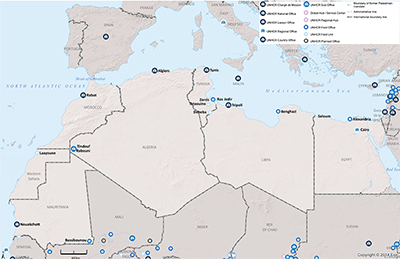
 (IPS) - Once surrounding castles of old, a moat stretching 100 miles is being dug by Tunisia against alleged terror threats from nearby Libya. Reporters are kept at bay from the digging in what officials have dubbed “a closed military area.”
Saltwater will fill the massive trench to be topped with sand dunes. Alligators are not mentioned in the moat’s prospectus.
“Why erect this wall when one was brought down between the two Germanies?” asked Salim Grira Mzioui, a local council representative of Wazen, a Libyan village along the border in an interview with the French newspaper Le Monde. “This will pose insurmountable problems. There are farmers cultivating land on both sides. There are also camel herds coming and going.”
The wall will put an end to ancestral traditions of border communities that have long ignored the state line artificially dividing entire tribes, he said. “We’re going to divide a people,” Adel Arjoun, a Tunisian hotel owner from Medenine, told Le Monde.
According to Tunisian officials, incursions by terrorists who target tourists prompted the decision to dig the barrier. Last June, for example, 38 foreign tourists were killed by a Tunisian said to be trained at a Libyan camp. Earlier, two attackers killed 21 foreign visitors at the Bardo Museum in Tunis.
But the small number of attacks suggests that Tunisia may be joining the anti-immigrant fever that has gripped some northern European countries.
And as the walls go up, the number of lives lost among desperate refugees is growing. Over 500 people leaving Libya were tossed into the seas when their vessels capsized.
Tunisia’s moat is only one of several misguided solutions to the swelling number of refugees fleeing war and extreme poverty. Hungary, Bulgaria and Greece are building walls. Ukraine plans to seal its 1200 mile border with Russia, and Estonia has a 70 mile wall in the works against the former Soviet Union.
Meanwhile, hundreds of Tunisians turned out to march against a draft bill for amnesty to those accused of corruption.
The draft bill is the centerpiece of the new government, which seeks to boost the economy by clearing away cases against businessmen and civil servants charged with corruption crimes.
Opponents of the law, however, call it as an attempt to whitewash the misdeeds of the old regime and ignore an ongoing process of transitional justice through the Truth and Dignity committee.
“We’re against the draft law because it is unfair and unconstitutional,” Sami Tahri, an official with the Union for Tunisian Workers, said at the protest. “It doesn’t fight corruption, it encourages it.”


Race permeates every facet of my life. No matter where I go, no matter what I do, I can never forget my skin color.

By LeRon Barton / The Good Men Project 


  I talk and write about race, a lot. It permeates every facet of my life. I cannot escape being Black, even if I wanted to. I have always been race conscious, known who I am, and where I stand in the world. However, everything changed for me during the Trayvon Martin trial. I saw not only how much vocal support George Zimmerman received from people, but also how much money was donated to protect a child killer. From that moment on, my world was shaken and I became almost hyper-sensitive towards race. From reading literary greats such as Toni Morrison and James Baldwin to present day brilliant sociologists like Cornell West and Dr. Tommy Curry, I have learned quite a bit about race in America. Along with my personal experiences as a 37-year-old Black man in America, I wanted to share with you 10 unfortunate, but true lessons I have learned being Black. 

    1. Respectability Politics will not save us – There is an unfortunate belief in the Black community that if you dress a certain way, i.e. wear a suit instead of baggy jeans, a v-neck sweater instead of a hoodie, and a collared shirt with a tie instead of a t-shirt you will be immune from racism. This is rooted in a belief called, “Respectability Politics” or “Look at us, we are normal law abiding citizens just like you white people.” Attorney and bestselling author Lawrence Otis Graham famously dressed his kids preppy to protect them from racism, but they were still called “nigger.” A Black man in a suit is looked at the same as a Black man in a hoodie – a threat. Eric Garner is just as dead as Martin Luther King Jr. Speaking of MLK…
    2. MLK is dead – In many of her essays on race, Dr. Stacey Patton brilliantly remarks, “white America has a necrophilia type relationship with Martin Luther King Jr.” Today America loves to laud MLK and promote his message of togetherness and unity, especially in light of the nationwide responses and protests to police terrorism. However, when King was alive, he was looked at differently. In 1966, two years before MLK was killed, a Gallup poll showed that 66% of America viewed him unfavorably. This is a stark contrast to many whites telling Blacks who want justice behind the murders of Freddie Gray and Mike Brown to “Be like MLK,” and forgive and love everyone.

    3. The sound of the police – Being pulled over by a police officer while driving is an unfortunate fact of life for a Black person. If you are driving it is inevitable. You can be the absolute best driver: traveling at the correct speeds, using your turn signals properly, and stopping at the stop sign perfectly. However, if you are DWB (driving while Black), you are susceptible to the flashing lights in the rearview mirror. I’ve been stopped by police so many times I no longer question if it is my mediocre driving skills. I know why I’m being stopped. It is what it is.

    4. Being the spokesperson for all Black people – This is also a regular occurrence in my life. Whenever I am in a work meeting, attend a social event, or any gathering of large amounts of people, I am usually one of the few, if not the only, Black person in the room. It is something that I have gotten used to. With that usually being the case, many whites also feel that I am the “Go-to Black person” or “Black representative” when they are curious about African American culture and stereotypes. You would not believe the asinine questions I get asked; it would boggle your mind. I just politely, remind them that “All negroes are not the same. We don’t all act like the Lyon family from ‘Empire’.” We are not a homogenous bunch. Speaking of that…

    5. Black people are not homogeneous – When I was younger I used to think that all Black people were aligned together against issues like racism, gender discrimination, and police terrorism, but that has been disproven. For every Cornell West and Jesse Williams who address racism and justice for all, there is a Herman Cain and Dr. Ben Carson pushing respectability politics, side stepping racism as if it does not exist. They espouse “rugged individualism,” a term my father taught me that means only doing for self and not your people. Some Black people don’t have interests in talking and discussing racism, or talking about police brutality. Some don’t even believe it is a problem; case in point a discussion I had with a fellow African American. He and I talked about the murder of Eric Garner. I said, “The police had no right to kill an unarmed man that was not doing anything.”  He says, “Well he shouldn’t have resisted.” I replied, “Garner was not resisting.” My then-friend followed up with, “Well, police never mess with me. I don’t give them a reason.” I was shocked and just shook my head.

    6. The purse clutch – Every Black man has experienced this. You are walking down the street, minding your own business, engrossed in your Beats by Dre headphones and you see a white woman walking near. You smile, not wanting to be looked at as the confrontational or scary Black person, but to her you are anyway and she does the “purse clutch “ (sounds like a dance right? Do the purse clutch!). This is when a white woman grabs her purse in fear that you are going to snatch it from her hands. I have had this happen to me since I was very young. I’ve seen women clutch their purse in the street as I walk by, the movie theater as I pass through the aisle, and the elevator when I get on. It’s as if some believe Black men are all robbers or thieves. I even experienced this with a suit on. As I said in truth #1, it does not matter what you wear, you are still Black. Nowadays I cross the street if I can or if I am in an elevator, I move to the far opposite side. I want to avoid that experience because every time it happens, a piece of my heart breaks.

    7. Am I a fetish? – I have this conversation every so often with friends who are in interracial relationships. We wonder, “Is the person with me because they like me or because I represent some kind of fantasy or fetish for them?” I have been on dates with white women and have been told, “I always wanted to know what it was like to be with a brother.” Comments like those and “once you go Black, you never go back” or does he have a BBC (use your imagination) have come up among my friends and I, so a person being sexually desired because of their race is not far-fetched.

    8. I always feel like somebody’s watching me – I cannot count how many times I am shopping in a department, electronic, and even convenient stores and I am slyly or blatantly followed by a store employee. I could be browsing suits to buy, looking for an iPhone 6, or even a case of the midnight munchies. If I turn around, there is an employee “hanging out” or fixing the merchandise…just in case I have a question. The most infamous time was when I had just moved to San Diego and went grocery shopping. As I was putting items in my grocery basket, a store clerk came right up to me and said, “Yeah that’s right, I am following you. I think you have been stealing.” That was my first and last time ever in that grocery store.

    9. Just because someone is LGBTQ, that doesn’t mean they are not racist – When I moved to San Francisco, I thought it was a liberal bastion. I heard The City was progressive, that everyone is accepting of everything, and home to a large LGBTQ population. And since the LGBTQ community has been historically discriminated against, I thought they couldn’t possibly be racist. Wrong, so wrong. Many of my gay friends who are not white tell me stories of discrimination and racism in their community. From barring entry into many gay night clubs and bars, being reduced to racial-sexual stereotypes (see #7), and an indifference to the Black and Latino plight. A friend of mine summed it up by saying: “Just because men sleep with other men and women sleep with other women, that doesn’t mean they don’t practice racism/white supremacy.”

    10. Anti-Blackness in Black communities – I define Anti-Blackness as disdain and distancing yourself from anything that can be considered Black. This belief is held throughout the world. In every ethnicity, the darker the person the more discrimination he or she faces. Unfortunately, this also pops up in Black communities such as Puerto Rican, Dominican, Cuban, and Brazilian, as many will deny their African roots. What many don’t understand is that during the Trans-Atlantic Slave Trade, many boats carrying Black slaves went to other places besides the United States: Puerto Rico, Dominican Republic, Cuba, and Brazil. Also, I have seen Anti-Blackness manifest in many African communities in the United States. Some African immigrants will try and distance themselves from American-born Blacks, saying that we are lazy, criminals, and have no morals. I worked with a guy from Kenya that when asked about this ethnicity, he would immediately say, “I am not African American, I am African. I am not like them in America.” Darn, even some Black folks in Africa don’t want to be considered Black .

   These are just a handful of examples that Black people face every single day. My purpose for writing this piece is not to whine and cry about “How hard Black people have it” but to illustrate how racism impacts our lives. Every day we have to maneuver around racism; there is not one moment of time when we can forget we are Black.

Alternet


   Turkish President Recep Tayyip Erdoğan's younger son Bilal Erdoğan, who was one of the prime suspects in Turkey's largest corruption case ever, has settled in Bologna, Italy, along with his wife and children  On Sunday night, the famous Turkish Twitter whistleblower Fuat Avni claimed that Bilal Erdoğan went to Italy on Sept. 27 with large sums of money.  

   Claiming that there is a plan in place for President Erdoğan and his family to escape if necessary after the Nov. 1 elections, the whistleblower also said Foreign Minister Feridun Sinirlioğlu is organizing the plan. Fuat Avni also tweeted on Monday that after Erdoğan's possible flight from the country was revealed, the presidential palace was concerned on Monday morning and there were fears the revelation would “cause resentment in the bureaucracy.” 

See full story here.

Update

On Oct. 6, the İstanbul 7th Penal Court of Peace demanded that Twitter block access to Fuat Avni's account in Turkey, but the social media website has refused to obey.