
Authorities in Tibet are engaging in preventive repression towards their population. As part of their nationwide 'stability maintenance' strategy, they are detaining, persecuting, and convicting Tibetans for non-violent forms of protest and other expressions of dissent such as assisting or supporting self-immolations and carrying pictures of the Dalai Lama.

The precise workings, nature, and scale of the Chinese Communist Party's efforts to imprison and detain Tibetans, however, remain poorly understood. In contrast with the body of knowledge on the detention and imprisonment of Uyghurs and other ethnic minorities in Xinjiang, the Tibetan detention system is still very much a black hole to the international community.

The lack of evidence on many issues, especially on the so-called 'vocational training centres' and detention through the criminal justice system, is not evidence of the absence of repression. Rather, it highlights a need for further research to address many of the research gaps and to better understand the situation.

This study therefore aimed to build on the scant available evidence and leveraged an innovative method — night-time lighting data — to shed light on the prisons and detention facilities in Tibet.

Measured on a daily basis using satellite-based sensors, night-time lighting data represent an equilibrium measure of electricity consumption at night at specific locations over time. Aggregated into monthly trends, these data can help illuminate potential changes in the construction, growth or decline in the use of specific detention facilities across Tibet that may not be visible using overhead satellite imagery alone.

Key Findings

  • There are at least 79 prisons and detention centres across Tibet.
  • The majority of these are assessed to be small, low-security detention centres which most likely provide low-level detention and short-term jail functions.
  • Almost all of these facilities were built before 2011, when Tibet's former Party Secretary Chen Quanguo (also known as the architect of repression in Tibet and Xinjiang) came to power in Tibet. Although we cannot rule out the possibility that Chen may have repurposed existing facilities for political purposes upon his arrival.
  • At the aggregate level, the overall size and scale of the Tibetan detention system has been relatively consistent over the past decade.
  • Zooming in on individual facilities, however, we uncovered recent patterns of growth in night-time lighting concentrated in higher security facilities since 2019.
  • This trend may suggest a shift towards longer detentions and imprisonments and is similar to recent observations in Xinjiang too, where a high percentage of these facilities showed active growth in night-time lighting in 2019 and 2020.
RAND Europe Corporation Institute


It’s been a minute since we last checked in on the tankies—that breed of humans who think imperialism is bad, but only the United States can be imperialist. As a result, everything that is bad in the world is the United States’ fault. No one else has agency or independence.

For example, they claim Russia had no choice but to launch its overtly imperialistic war against Ukraine, because it was simply responding to American efforts to surround Russia with its NATO puppets. They are big supporters of the concept of the “global south,” a supposed coalition of developing nations led by global-north nations Russian and China (despotic regimes—a feature, not a bug) as a counterweight to Western hegemony. This pretty much sums it up:

Der russische Diktator Wladimir Putin hat die westpolnischen Gebiete als "Geschenk" des sowjetischen Diktators Josef Stalin bezeichnet und behauptet, dass es sein Handeln war, das Polen dazu veranlasste, dieses Gebiet nach dem Zweiten Weltkrieg von Deutschland zu erhalten.

"Die westlichen Gebiete des heutigen Polens sind ein Geschenk Stalins an die Polen, haben unsere Freunde in Warschau das vergessen? Wir werden sie daran erinnern", drohte Putin bei einem Treffen mit Mitgliedern des russischen Sicherheitsrates am 21. Juli.

Lesen Sie auch: Pro-russische Anhänger demonstrieren in Warschau und fordern ein Ende der Unterstützung für die Ukraine

Der Diktator wies auch den Direktor des Auslandsgeheimdienstes (SVR), Sergej Naryschki, an, die mögliche Absicht Polens zu überwachen, "die Westukraine zu besetzen". Es gibt keinen Hinweis darauf, dass dies möglich wäre.

Nach Putins Vorstellung könnte eine "polnisch-litauisch-ukrainische Initiative auf dem Gebiet der Sicherheit" die Westukraine "besetzen". Belege dafür hat er nicht geliefert.

Lesen Sie auch: Krim - Das Echo von Europas unausgesprochenem Völkermord wird zu laut, um es zu ignorieren - Stellungnahme

Er drohte Polen mit dem Verlust seiner Unabhängigkeit als Folge einer "solch aggressiven Politik". Putin behauptete auch, dass Polen seine Unabhängigkeit der Sowjetunion verdanke.

Am 21. Mai beschuldigte der Sprecher der russischen Staatsduma, Wjatscheslaw Wolodin, Polen des "Verrats am historischen Gedächtnis" und behauptete, das Land schulde Moskau über 750 Milliarden Dollar für die Befreiung von Nazi-Deutschland und den Wiederaufbau des Landes.

"Seit Jahrhunderten ist Russland großartig darin, die Dinge auf den Kopf zu stellen, um uns hinters Licht zu führen", kommentierte der polnische Premierminister Mateusz Morawiecki die absurden Behauptungen Wolodins.

 
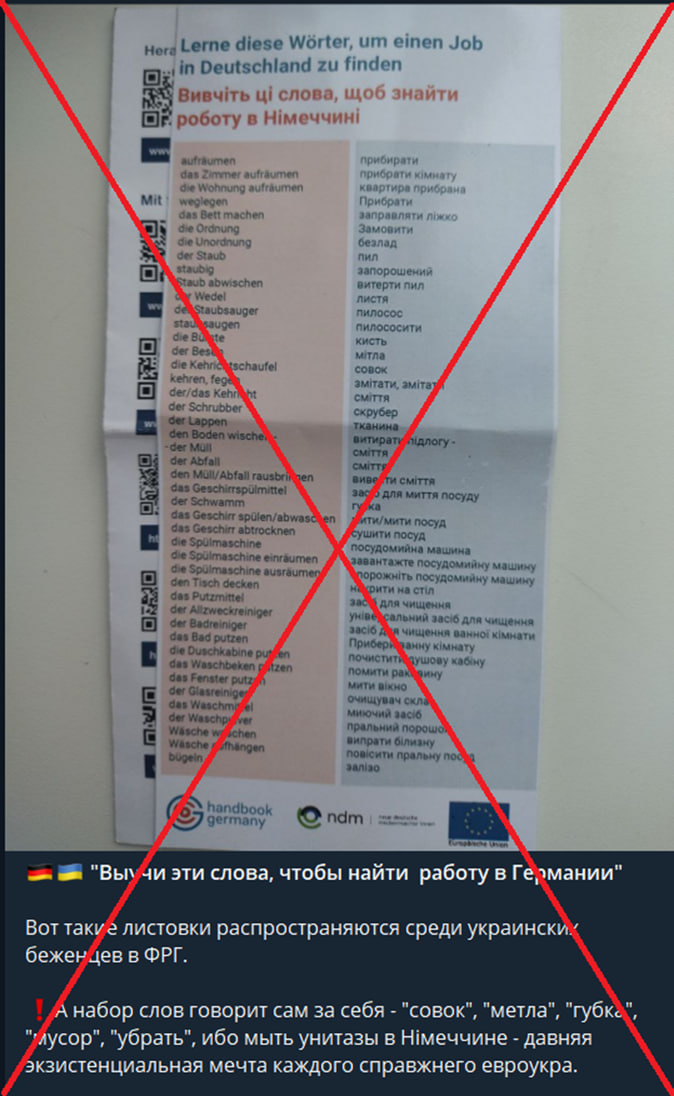
Propagandists provided Ukrainians with a "list of words" they need to know to be employed in Germany

post illustrated with a photo of a leaflet appeared in z-Telegram channels the other day. It shows a list of German words with a Ukrainian translation.

All of them are related to housework, and at the top it says: "Learn these words to find a job in Germany." In addition, at the bottom of the leaflet you can see the logo of the NdM association which stands for diversity in journalism and combats bullying on the Internet. The leaflet also has the logo of the Handbook Germany project which is supported by NdM and deals with the adaptation of the life of foreigners in Germany. It follows from the idea of the propagandists that Ukrainian refugees in Germany can only do housework.

This is a fake. The Russians made a number of mistakes in the translation of the leaflet. In German, nouns are capitalized and preceded by an article. In addition, all German verbs in the infinitive end in n or en. However, the propagandists "translated" the noun die Ordnung [order] as "to order" and the verb bügeln [to iron] as "iron". It is interesting that the machine translation produces exactly the results that the Russians used. This confirms that the leaflet was created not by native speakers.

UKRINFORM


Zu den Aufgaben des russischen Spionagerings, der in diesem Jahr in Polen aufgedeckt wurde, gehörten Sabotageakte bei der Eisenbahn, darunter das Legen von Bomben, um Züge mit militärischer und humanitärer Hilfe für die Ukraine entgleisen zu lassen.
Dies berichtet die Gazeta Polska, die über den Fall berichtet, der von der Agentur für innere Sicherheit und der polnischen Staatsanwaltschaft untersucht wird, die das russische Spionagenetz im Visier haben, berichtet Ukrinform.

"Von März bis Juli wurden insgesamt 15 Personen festgenommen und wegen Spionage für den russischen Militärgeheimdienst GRU angeklagt. Ihnen drohen bis zu 10 Jahre Gefängnis", heißt es in dem Bericht.

Die Zeitung weist darauf hin, dass es sich um den größten russischen Spionagering handelt, der jemals in Polen aufgedeckt wurde. Er bestand aus Bürgern aus Russland, Weißrussland und der Ukraine.

Wie bereits erwähnt, wird die Untersuchung von der Staatsanwaltschaft in Lublin geleitet. Insgesamt wurden in diesem Fall bereits 66 Aktenbände gesammelt. Die Festgenommenen haben ausgesagt, dass sie unter anderem geplant hatten, Züge mit Waffen und humanitärer Hilfe für die Ukraine zu sprengen.

"Die Gefahr von Terroranschlägen war zu groß, um die Gruppe einfach weiter zu überwachen", heißt es in der Veröffentlichung.

Es wird betont, dass die Mitglieder des Spionagenetzwerks Aufträge direkt aus Moskau erhielten und auch Belohnungen in Kryptowährung, meist in Bitcoins, erhielten, die dann in Bargeld umgetauscht wurden.

UKRINFORM