ASources told the outlet that North Korean units now undergo twice-weekly political indoctrination sessions where commanders glorify soldiers who blew themselves up on the battlefield. These sessions promote the idea that such actions demonstrate loyalty to Kim and surpass the bravery of Russian troops fighting alongside them.
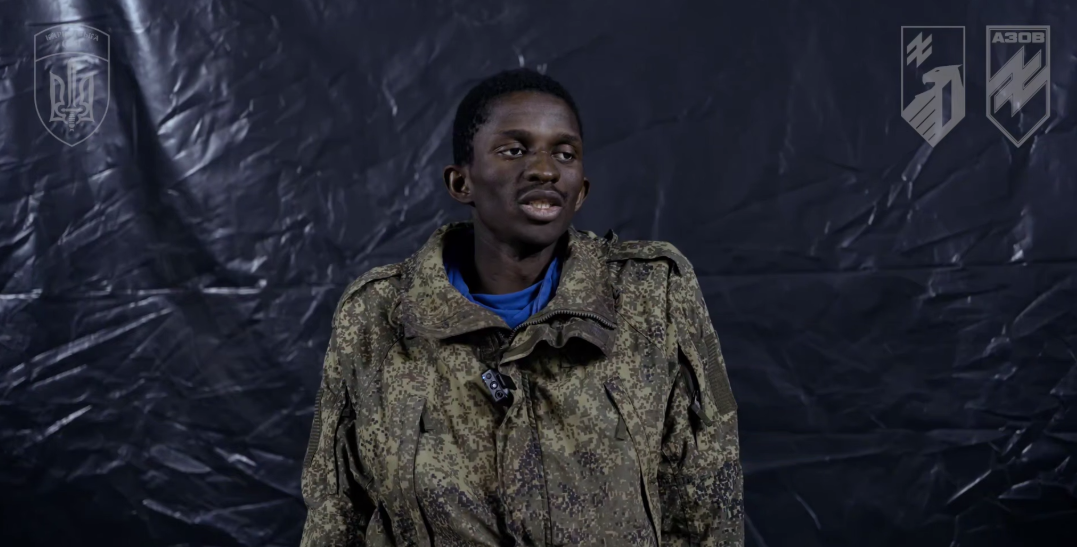
Ukrainian forces say they are fighting against a “large number of Africans” serving on the Russian side along the Lyman direction in northern Donetsk Oblast. The intensity of Russian actions here is extremely high. The invaders are attempting to infiltrate and are pressing from multiple directions, ArmyInform reports.
Ukrainian forces say they are fighting against a “large number of Africans” serving on the Russian side along the Lyman direction in northern Donetsk Oblast. The intensity of Russian actions here is extremely high. The invaders are attempting to infiltrate and are pressing from multiple directions, ArmyInform reports.
Duduzile Zuma-Sambudla, a daughter of former South African president Jacob Zuma, has resigned from parliament amid allegations that she lured 17 men to fight for Russia in Ukraine, her party said. (Reuters)
Hong Kong burning
The terrible blaze killing dozens and destroying residential buildings in Hong Kong comes as no surprise. Hong Kong is one of the world's most expensive building areas. Huge 31-storey buildings next to each other are a trap by themselves. However, a fire hazard is not what the dwellers of these human beehives fear most: it's burglary. Many balconies on all levels are barred and blocked with wooden structures s by their inhabitants to prevent thieves climbing up from the level below or descending from the level above from entering
--ed
.
Ukrainian security source says Russia reacted to an attack by firing missiles into its own buildings
Russia fired surface-to-air missiles into its own residential buildings while responding to a large Ukrainian attack against an oil terminal on the Black Sea, a security source told Business Insider on Tuesday.
Ukrainian forces carried out a large attack on Novorossiysk, a key city for Russian oil exports.
Russia reacted to the attack by launching missiles at its own buildings, a Ukrainian security source said.
The attack on Tuesday marked Ukraine's latest targeting of the Russian energy sector.
Russia fired surface-to-air missiles into its own residential buildings while responding to a large Ukrainian attack against an oil terminal on the Black Sea, a security source told Business Insider on Tuesday.
The war has changed its face. Ukraine's superiority in the drone sky is over. Russian soldiers are sent into the combat zone in small groups, often just two at a time and sometimes alone, where – if they survive the journey – they hide and wait for more comrades to arrive before attacking Ukrainian positions. There are no longer any clear front lines, but rather large gray areas where Ukrainian and Russian infantrymen watch and hunt each other.
Another new development is that there are fewer wounded than before. This is because it is hardly possible to evacuate them to military hospitals. Those who are seriously injured die a slow death in a hole in the ground. If you wonder why young men from Ukraine who are fit for military service can be found in German cities instead of fighting at home, the contours of an answer are beginning to emerge. The picture is still incomplete. It's not getting any better.
The Russian aggressors have improved their technology, tactics, and the range of their drones. The zone of observation and killing from the air now extends 20 kilometers behind Ukrainian lines. There, the losses among support units and drone pilots even exceed those of the infantrymen operating on the front lines. Russia has tactically gained the upper hand.
The Kremlin's army is slowly pushing back the defenders, sometimes abruptly. Anyone who falls into the hands of Putin's soldiers can expect terrible things. Torture and murder of prisoners have been documented on a massive scale.
Some Russian killers make a sport of it. The neo-Nazi unit “Rusitsch” has called for photos of murdered Ukrainian prisoners of war to be posted on social media. Cash prizes await the fastest submitters. Young Ukrainians in Germany are also seeing these messages.
What happens next? Because Moscow is paying for its advance with around 25,000 deaths per month and units are bleeding out just as fast as new cannon fodder is filling the ranks, a dramatic breakthrough is not to be expected. The attackers lack the strength to exploit the Ukrainian defenders' shortcomings on a large scale. Their biggest problem – depleted troops, lack of personnel – remains unresolved. President Zelensky has so far shied away from conscripting young men under the age of 25 to serve on the front lines, relying instead on volunteers. That has not worked.
This can be observed among older civilians who are liable for military service. They are hunted down by pursuers who drag them violently into minibuses. They then end up in basic training and afterwards on the front line – or at least that's the plan. Because those who can, run away. Recently, the public prosecutor's office has registered more cases of desertion than ever before: 20,000 soldiers stayed away from the troops last month alone. Young recruits often come to the same conclusion as old hands who, even after years of fighting, are not allowed to leave the death zone and ultimately give themselves the order to be discharged from the army: off home.
Added to this is a scandal that has been festering in Kiev for months but is only now beginning to unfold in full force. While grenades rain down on the front lines and bombs rain down on the cities in the hinterland, Zelensky's cronies have enriched themselves with such shamelessness that even Ukrainians accustomed to corruption are left speechless. It's all there: from the golden toilet bowl to the accomplice who, in a wiretapped conversation, complains that carrying the bags of money is giving him back pain. The scandal reaches into the inner circle of the president, whose political future suddenly seems uncertain.
Zelensky's weakness is setting in motion a peace process that is not really a peace process. The most ardent supporters of Russia in Donald Trump's team sense an opportunity and are circulating a plan that Putin himself could not have dictated better and that amounts to Ukraine's surrender. “This plan would not end the war. It would prepare for the next war,” my colleague Simon Cleven analyzes.
It is unlikely that Ukraine will accept this list of Russia's maximum demands and that the horrors of war will thus come to an end. However, there are a few more striking colors to add to the overall picture presented to Ukrainian men who are to be sent to the front. Poor prospects, a faltering leadership, and corrupt individuals in high office who view the country as a self-service store in the midst of the horrors of war: That's not worth risking your life for.
This is how Ukraine remains trapped in an endless loop. There is a shortage of soldiers willing to fight, which leads to retreats and high casualties, which in turn leads to a shortage of soldiers willing to fight. It's understandable. But this vicious circle cannot be broken. Does Zelensky still have the strength or support to mobilize more people for the front? Or to win them over to an uncomfortable peace after all the sacrifices? The war continues. The questions change.
As Moscow steps up its announcements of “revolutionary” weapons capable of bypassing all Western defenses, from Poseidon to Bourevestnik and new hypersonic missiles, one question begs to be asked: is this technological reality or strategic bluff?
Some countries have nuclear-powered vessels: nuclear-powered aircraft carriers, including in France, and nuclear-powered submarines. According to statements by Vladimir Putin, Russian scientists have succeeded in applying this nuclear propulsion system to a missile. According to the Kremlin leader, this is a missile capable of reaching any point on the planet and remaining in orbit for a very long time to strike any area of the globe.
Such a device must be very heavy, since it involves replicating a military nuclear reactor on a missile, which must weigh a lot. This also means that the weight of the warheads must be limited so that the missile can carry them. The cost is prohibitive and, according to several experts, the Russian Federation is not in a position to manufacture large numbers of such missiles, as it lacks the industrial capacity for large-scale production. There is also uncertainty about how it works, as there has already been a failure during an initial series of tests.
We have no independent evidence that this missile actually worked as described by Vladimir Putin. It seems that Western countries, notably the United States and some European countries, have also taken an interest in this type of project. They have studied the feasibility of such a device and concluded that the technology is too costly.At the prototype stage, missiles are extremely expensive. This is the principle of economies of scale. When launching a new product, whether civilian or military, the first models are very costly. The cost price is prohibitive, much higher than that of existing missiles, whether cruise missiles or ballistic missiles. This program is therefore extremely expensive compared to current programs.
Russian Chief of Staff Yuri Baluyevsky unveils a doctrine of “digital warfare” born on the Ukrainian front, where the total transparency imposed by drones relegates tanks and artillery to the past and makes computing power the new strategic pivot, to the point of shaking the very foundations of nuclear deterrence.The Chief of the General Staff of the Russian Armed Forces, Yuri Baluyevsky, has just published a strategic note in the journal Russia in Global Affairs, which Le Grand Continent has translated in its entirety. In it, he describes a spectacular doctrine, entirely based on experience gained in Ukraine—a battlefield where drones and technology are disrupting traditional patterns.Now, no one can hide; everything is transparent. For him, infantry and tanks are losing their usefulness: the urgent need is to decentralize command centers and invest heavily in computing power, which is morefundamental than traditional weaponry. These are the broad outlines of this dizzying doctrine of “digital warfare,” which could even challenge the balance of nuclear deterrence.Drones have radically changed warfare. They are autonomous, can detect everything, and can penetrate far behind the front line. The Chief of Staff of the Russian Armed Forces describes a highly exposed battlefield:“The tactical operations area and the rear, up to several kilometers from the contact zone, are gradually becoming ‘extermination zones.’”
Ukraine and Russia are each buying several hundred thousand drones per month, which is more than the production of artillery ammunition. These drones are connected to each other, capable of flying in swarms, and cause a great deal of human damage, admits the Russian chief of staff: ""These drones, which swarm over any soldier they spot, have become the main cause of destruction not only of equipment but also of military personnel. By early 2025, according to Russian statistics, more than 70% of combatant losses were attributable to drones."Tanks are rendered useless against swarms of connected drones.
The Russian strategist even imagines swarms of drones that will no longer need human control to carry out strikes. The army with the most drones will gain the upper hand, he warns. In this configuration, camouflage is no longer possible because the battlefield has become completely transparent.
As a result, Yuri Balouevski imagines an army where soldiers and equipment are interconnected, where war is waged remotely. In this new war, the enemy no longer needs to be in the field of vision. The tank, heavy and visible, loses all its usefulness: “Today, the tank appears to be an easily detectable and destructible target, with a weapon system that is not very effective for combat in the field of vision. The tank has lost the place it once occupied: that of the army's main means of breakthrough and maneuver.”
As a result, Yuri Balouevski imagines an army where soldiers and equipment are interconnected, where war is waged remotely. In this new war, the enemy no longer needs to be in the field of vision. The tank, heavy and visible, loses all its usefulness: “Today, the tank appears to be an easily detectable and destructible target, with a weapon system that is not very effective for combat in the field of vision.
The tank has lost its former position as the army's primary means of breakthrough and maneuver. The same diagnosis applies to conventional artillery—cannons, shells, rocket launchers. Drones now far surpass it. According to Yuri Balouevsky, this digital warfare has wiped out all the doctrines inherited from the industrial revolution: “The campaign in Ukraine has put an end to nearly a century of domination by the mechanized warfare models characteristic of industrial societies.”
$200 billion of secret Chinese loans to U.S. businesses
China’s state lenders have funneled $200 billion into U.S. businesses for a quarter of a century, but many of the loans have been kept secret because the money was first routed through shell companies in the Cayman Islands, Bermuda, Delaware and elsewhere that helped obscure their origins, according to AidData, a research lab at the College of William & Mary in Virginia.
More alarming, much of the lending was to help Chinese companies buy stakes in U.S. businesses, many tied to critical technology and national security, including a robotics maker, a semiconductor company and a biotech firm.
In der umkämpften Stadt Pokrowsk in der Region Donezk nutzte das russische Militär Zivilisten als “, teilt die regionale Staatsanwaltschaft auf Telegram mit.
„Am 10. November 2025 haben Vertreter der Armee des Aggressorstaates erneut das Völkerrecht verletzt. Gegen 14 Uhr 30 hat der Kommandeur einer russischen Einheit seine Soldaten, die in Pokrowsk eingedrungen sind, per Funk angewiesen, Zivilbevölkerung als „menschlichen Schutzschild zu verwenden“.hieß es. Bei der sogenannten Säuberung des Wohngebiets sollten sie einen Mann, eine Frau und ein 13-jähriges Kind vor sich platzieren. "Unter der Verfahrensleitung der Staatsanwaltschaft der Region Donezk wurden Voruntersuchungen zu den Tatsachen von Kriegsverbrechen (Artikel 438 des Strafgesetzbuches der Ukraine) eingeleitet", hieß es weiter.
DaDeutschland danach strebt, Europas vorherrschende Militärmacht zu werden, verschiebt sich das politische Gleichgewicht. In Frankreich bemüht man sich, relevant zu bleiben, während in Polen die Wiederaufrüstung Deutschlands alte Geister weckt und das Gefühl entsteht, dass ein Bündnis zwischen Berlin und Warschau der effektivste Weg sein könnte, um Russland in Schach zu halten.
Ein Deutschland mit der größten Armee Europas, ausgestattet mit modernsten Panzern, Raketen und Jets, ist weit entfernt von der chaotischen Bundeswehr, die wegen ihrer schlechten Moral und veralteten Ausrüstung verspottet wurde.
Während Paris mit einer Verschuldung von über 110 Prozent des BIP und einem Defizit von über 5 Prozent zu kämpfen hat, verschafft Berlins Kreditwürdigkeit ihm eine Freiheit, um die seine Nachbarn es nur beneiden können.
Berlin schützt nach wie vor seine nationalen Vorrechte im Verteidigungsbereich. Dieser „Germany first”-Ansatz nimmt bereits Gestalt an. Weniger als 10 Prozent der neuen Aufträge gehen an US-Lieferanten – eine Umkehrung nach Jahren, in denen Berlin einer der wichtigsten Verteidigungskunden Washingtons war.
Trotz der Bemühungen des französischen Präsidenten Emmanuel Macron seit 2017, die deutsch-französischen Beziehungen zu verbessern, ist das Misstrauen gegenüber Berlin in französischen Verteidigungskreisen nach wie vor tief verwurzelt. Die jüngsten Spannungen um das Projekt für einen europäischen Kampfflugzeug der nächsten Generation – das Future Combat Air System (FCAS) – haben das Unbehagen nur noch verstärkt. Das 100 Milliarden Euro teure Programm sollte das Kronjuwel der deutsch-französisch-spanischen Verteidigungszusammenarbeit werden.
Doch Verzögerungen und Streitigkeiten darüber, welches Land einen größeren Anteil an den Arbeiten erhält, stellen diese Partnerschaft auf eine harte Probe. Wenn Berlin viel Geld ausgibt und sich dabei hauptsächlich mit nordischen und östlichen Verbündeten zusammentut, läuft Paris Gefahr, seine seit langem bestehende zentrale Rolle in der europäischen Verteidigungsarchitektur zu verlieren.
Allerdings sieht nicht jeder die Wiederaufrüstung Deutschlands als Bedrohung an. In Warschau wird sie als notwendig und längst überfällig angesehen.
A new age assessment system has enabled Greece to establish that more than half of its asylum seekers are lying when they claim to be minors. This is the latest measure taken by Athens to combat illegal immigration.
The new Greek age verification system for migration policy has revealed that the majority of asylum seekers are lying about their age, claiming to be minors, according to details provided by the Greek Minister of Migration and Asylum, Thanos Plevris.Mr. Plevris said that out of 104 cases examined since the end of August, 59 people have been identified as adults. “The consequences for those who have made false declarations are obvious,” he said.
It feels impossible to deny that AI chatbots have a uniquely persuasive power, more so than any other widely available technology. They can act like a “sort of echo chamber for one,” Morrin, a doctoral fellow at King’s College, told the magazine. Not only are they able to generate a human-like response to virtually any question, but they’re typically designed to be sycophantic and agreeable. Meanwhile, the very label of “AI” insinuates to users that they’re talking to an intelligent being, an illusion that tech companies are gladly willing to maintain.
Morrin and his colleagues found three types of chatbot-driven spirals. Some suffering these breaks believe that they’re having some kind of spiritual awakening or are on a messianic mission, or otherwise uncovering a hidden truth about reality. Others believe they’re interacting with a sentient or even god-like being. Or the user may develop an intense emotional or even romantic attachment to the AI.
The Ukrainian funeral sector has not been spared by corruption. This phenomenon, which predates the war but was largely ignored, has accelerated over the past three years. The families of the deceased are the first victims. What matters is being the first to arrive. Ivan's boss, who works for a funeral home in Ukraine, constantly reminds his teams that when someone dies, they must be on the scene before the competition. “We hunt for bodies,” explains the 39-year-old Ukrainian bluntly. When a bombing occurs, he immediately rushes to the scene to offer his services to the bereaved families. Sometimes, agents from different funeral companies arrive at the scene at the same time and come to blows.
Trump Admin Pushes to Weaken Ukraine Resolution on Russian Occupation at UN
In a surprise reversal that has alarmed Ukraine and its allies in the UN, the Trump administration is pushing to strip language from a resolution that affirms the country’s territorial integrity and condemns Russia’s occupation of Crimea and other regions, according to two people familiar with internal UN discussions. The text explicitly recognized Ukraine’s territorial integrity and sovereignty, condemned Russia’s annexation of Crimea, and detailed the worsening human-rights situation in occupied territories.Now, Washington wants those references removed. Two diplomatic sources told Kyiv Post that the US side is pressing for the resolution to be recast under the broader label of the “war in Ukraine,” without references to “territorial integrity” or “aggression.”
Immigration and Customs Enforcement (ICE) — the agency supposedly tasked with deporting undocumented immigrants — just tried to deport an Indigenous woman whose ancestors have been here for thousands of years.Leticia Jacobo, a 24-year-old member of Arizona’s Salt River Pima-Maricopa Indian Community, was born in Phoenix — but that didn’t stop ICE from trying to ship her “back” to a country she doesn’t even belong to.
Here’s how this jaw-dropping injustice unfolded: Jacobo was sitting in a Polk County, Iowa jail after being booked for allegedly driving with a suspended license — nothing violent, nothing serious.
Her mother, Ericka Burns, was preparing to pick her up and bring her home when jail staff dropped a bombshell: “She’s not being released. ICE is coming to deport her.”Her mom was stunned. “How can you deport her?” she asked. “She’s Native American!”
But the jail staff shrugged it off. They said they were “just holding her” for ICE.
40% of Australian women without kids hesitant to have children because of climate change
Half of Australians were very or extremely concerned about climate change and two in five believed the climate would be “much hotter” in 2050.
Commissioned by Clive Hamilton, a professor of public ethics at Charles Sturt University, and carried out by Roy Morgan Research, the survey also found that more than a third of Coalition voters believed the climate would not change at all.
Among non-parents, 40.4% of women said they were moderately or very hesitant about having children because of the changing climate, but only 17% of men (one in six) reported the same. Rising levels of climate concern could result in a decline in Australia’s birth rate, Hamilton added.
It starts remarkably young these days. Ten-year-olds are saving their allowances for $70 moisturizers and $90 serums, mimicking influencer routines meant for adults. Girls as young as eight have suffered chemical burns and rashes from overusing anti-aging products whose pastel packaging and “glow” marketing make them irresistible on TikTok. Even before adolescence, the youth themselves are performing refinement—an early initiation into the aesthetics of conspicuous consumption.
Russia has amassed 170,000 troops in the battle for a single city, Pokrovsk, almost the equivalent of the entire German Bundeswehr forces. Russia is now attempting to take a single city with an army comparable in size to the one originally intended to seize all of Right-Bank Ukraine.
Russia Sends 170,000 Troops—More Than Most European Armies—to Capture One Ukrainian City
Pokrovsk is the Kremlin’s top military objective through the end of the year. Nearly a third of all Russian forces stationed in Ukraine have been redeployed to this front.
To put this into perspective: the Russian force outside Pokrovsk is larger than the combined standing armies of 10 European countries, excluding reservists.
Ukrainian commanders state plainly: Russia is sending waves of soldiers to certain death in such numbers that even FPV drones can’t be launched quickly enough to eliminate them. Meanwhile, Russian field officers reportedly shoot their soldiers for refusing going on "suicide" assaults.
WWII Veteran Breaks Down Over State Of Home Country
The state of things over in England, and Europe at large, is fairly dire at the moment.
The country has been flooded by immigrants from African nations and the Islamic world for the better part of two decades now, causing many native Britons to push back, calling for immigration reform to "protect British interests."
It's gotten to the point where many are questioning the identity of their home country and whether there will be an England left for their future generations at this point.
One man who has seen it all and even fought for the country he loves so dearly is 100-year-old World War II veteran, Alec Penstone.
When asked what Remembrance Sunday means to him, Penstone, as he fought back tears, questioned whether the sacrifices were all worth it.
Imagine being in this man's shoes.
80 years ago, you fought against tyrannical forces to preserve the freedom of the country you were born in, raised in, and, God willing, will die in.
As you aged, you saw the demographics of your nation start to slowly shift, until one day you looked around, and the England you knew ceased to exist a long time ago.
It's hard not to get emotional hearing Penstone lament all the lives lost during World War II, looking over "rows and rows of white stones… of [friends] who gave their lives."
OutKick'Heroes like Alec fought so that we could hand Britain over to this mob' GBNews.com
U.S. military seeking aid from food banks in Germany?
The website for a U.S. Army base in Germany provided a list of available German food aid services, highlighting the fallout experienced by many as the GOP’s government shutdown rages on.
After the listing was first reported—raising questions about why military members and their families would need these resources—the information was scrubbed from the website. The Army claimed that the list was intended for “German employees” on the base.
But it should be noted that, undercurrent Defense Secretary Pete Hegseth, the Department of Defense has often misled the public on matters both trivial and consequential. It has also embraced partisanship and censorship of Pentagon reporters. Thanks to the GOP shutdown, there has been a spike in military families seeking aid from food banks. Cori Kauk, executive director of Bremerton Foodline in Washington, told Stars and Stripes that families had a “fear of scarcity” and “worries about being on the edge financially.”
The website for a U.S. Army base in Germany provided a list of available German food aid services, highlighting the fallout experienced by many as the GOP’s government shutdown rages on.
After the listing was first reported—raising questions about why military members and their families would need these resources—the information was scrubbed from the website. The Army claimed that the list was intended for “German employees” on the base.
A cartoon by Pedro Molina.
The shutdown has also increased concerns about military pay.
Events on the Pokrovsky Line continue to be very fluid. Denys Davydov, the Ukrainian vlogger, who has of late been quite down cast in his reportage of Pokrovsk was very HaPpY hippy happy today based on what he has been seeing within the city itself and the continued Ukrainian stalwart defense of nearby Myrnohrad and Rodynske.
The videos are out there but I will not link to them. Denys Davidov also didn’t show them because of the absolutely horrendous and catastrophic loss of Russian lives in the last couple of days. Dozens and dozens strewn about the agricultural landscape along with their burning tanks and APCs.
He queued up his day-to-day map and saw no advancement by the Russian forces. Further that within Pokrovsk itself the Russian infils and SRGs earlier spotted in various parts of the city which became the source of so much alarm appear to have been eliminated (?). As well that Ukrainian forces have now been geo-located in places previously credited as Russian controlled.
And the Ukrainian flag flies again over Pokrovsk city hall.
This interesting table reveals, for instance, that fast growing Poland is well on its way to match the GDP levels of UK and Italy. It also shows how a relatively rich Russia is confronting a bitterly poor Ukraine.
--ed
TheInternational Monetary Fund is publishing economic growth rates by country. This table makes interesting reading:% Real GDP growth, October 2025World Economic Outlook
The above table shows that only a few European countries sport growth rates above 2 percent: Ireland (9.1), Malta (3.9), Albania (3.4),Poland (3.2), Spain (2.9), Cyprus (2.9), Serbia (2.4), Czech Republic (2.3) and Greece (2). All other European countries including the big ones -- UK, France, Germany, Italy and yes, Russia -- are stuck in the doldrums. A continent on the way to become a museum of yesterday's life. Pretty and old-fashioned, good for tourism but not much else,


 https://euromaidanpress.com/wp-content/uploads/2025/11/Безіменний-300x152.png 300w, https://euromaidanpress.com/wp-content/uploads/2025/11/Безіменний-1024x520.png 1024w, https://euromaidanpress.com/wp-content/uploads/2025/11/Безіменний-380x193.png 380w, https://euromaidanpress.com/wp-content/uploads/2025/11/Безіменний-800x406.png 800w" alt="" width="1077" height="547" class="attachment-full size-full wp-post-image" style="box-sizing: border-box; vertical-align: middle; border-style: none; max-width: 100%; height: auto; object-fit: cover; width: 800px; border-radius: 0px;" decoding="async" />