
Even as the group has publicly celebrated its work, insider accounts detail a string of failures 


   The neighborhood of Campeche sprawls up a steep hillside in Haiti’s capital city, Port-au-Prince. Goats rustle in trash that goes forever uncollected. Children kick a deflated volleyball in a dusty lot below a wall with a hand-painted logo of the American Red Cross.

   In late 2011, the Red Cross launched a multimillion-dollar project to transform the desperately poor area, which was hit hard by the earthquake that struck Haiti the year before. The main focus of the project — called LAMIKA, an acronym in Creole for “A Better Life in My Neighborhood” — was building hundreds of permanent homes.

   Today, not one home has been built in Campeche. Many residents live in shacks made of rusty sheet metal, without access to drinkable water, electricity or basic sanitation. When it rains, their homes flood and residents bail out mud and water.

   The Red Cross received an outpouring of donations after the quake, nearly half a billion dollars.

   The group has publicly celebrated its work. But in fact, the Red Cross has repeatedly failed on the ground in Haiti. Confidential memos, emails from worried top officers, and accounts of a dozen frustrated and disappointed insiders show the charity has broken promises, squandered donations, and made dubious claims of success.

   The Red Cross says it has provided homes to more than 130,000 people. But the actual number of permanent homes the group has built in all of Haiti: six.

   After the earthquake, Red Cross CEO Gail McGovern unveiled ambitious plans to “develop brand-new communities.” None has ever been built.

   Aid organizations from around the world have struggled after the earthquake in Haiti, the Western Hemisphere’s poorest country. But ProPublica and NPR’s investigation shows that many of the Red Cross’s failings in Haiti are of its own making. They are also part of a larger pattern in which the organization has botched delivery of aid after disasters such as Superstorm Sandy. Despite its difficulties, the Red Cross remains the charity of choice for ordinary Americans and corporations alike after natural disasters.

   One issue that has hindered the Red Cross’ work in Haiti is an overreliance on foreigners who could not speak French or Creole, current and former employees say.

   In a blistering 2011 memo, the then-director of the Haiti program, Judith St. Fort, wrote that the group was failing in Haiti and that senior managers had made “very disturbing” remarks disparaging Haitian employees. St. Fort, who is Haitian American, wrote that the comments included, “he is the only hard working one among them” and “the ones that we have hired are not strong so we probably should not pay close attention to Haitian CVs.”

   The Red Cross won’t disclose details of how it has spent the hundreds of millions of dollars donated for Haiti. But our reporting shows that less money reached those in need than the Red Cross has said.

   Lacking the expertise to mount its own projects, the Red Cross ended up giving much of the money to other groups to do the work. Those groups took out a piece of every dollar to cover overhead and management. Even on the projects done by others, the Red Cross had its own significant expenses – in one case, adding up to a third of the project’s budget.

Where did the half billion raised for Haiti go? The Red Cross won’t say.

 
In statements, the Red Cross cited the challenges all groups have faced in post-quake Haiti, including the country’s dysfunctional land title system.

   “Like many humanitarian organizations responding in Haiti, the American Red Cross met complications in relation to government coordination delays, disputes over land ownership, delays at Haitian customs, challenges finding qualified staff who were in short supply and high demand, and the cholera outbreak, among other challenges,” the charity said.

   The group said it responded quickly to internal concerns, including hiring an expert to train staff on cultural competency after St. Fort’s memo. While the group won’t provide a breakdown of its projects, the Red Cross said it has done more than 100. The projects include repairing 4,000 homes, giving several thousand families temporary shelters, donating $44 million for food after the earthquake, and helping fund the construction of a hospital.

   “Millions of Haitians are safer, healthier, more resilient, and better prepared for future disasters thanks to generous donations to the American Red Cross,” McGovern wrote in a recent report marking the fifth anniversary of the earthquake.

   In other promotional materials, the Red Cross said it has helped “more than 4.5 million” individual Haitians “get back on their feet.”

   It has not provided details to back up the claim. And Jean-Max Bellerive, Haiti’s prime minister at the time of the earthquake, doubts the figure, pointing out the country’s entire population is only about 10 million.

   “No, no,” Bellerive said of the Red Cross’ claim, “it’s not possible.”

Justin Elliott -- ProPublica,  Laura Sullivan -- NPR

See the full report here


Update

Sen. Charles Grassley is demanding the American Red Cross explain how it spent nearly half a billion dollars raised after the 2010 Haiti earthquake. In a letter to Red Cross CEO Gail McGovern, the Iowa Republican gave the venerated charity until July 22 to answer 17 detailed questions, many of which it has never addressed publicly.


by Justin Elliott, ProPublica, and Laura Sullivan, NPR
  The Washington Post is getting around to a story that both Mother Jones and the New York Times have covered: Jeb's dicey business deals.

   What's striking is that all three publications have essentially come to the same conclusion, reporting that Jeb routinely traded on his family name at inappropriate times in order to open doors. Here's a revealing passage from the Post about Jeb leveraging his status as the son of a sitting president on a business trip to Nigeria in 1989:

   “My father is the president of the United States, duly elected by people that have an interest in improving ties everywhere,” he told a group of dignitaries in a private meeting, according to a video documenting the visit. “The fact that you have done this today is something I will report back to him very quickly when I get back to the United States.”Just days after Jeb Bush returned home, President George H.W. Bush sent a note to Nigerian President Ibrahim Babangida, thanking him for hosting his son. “We are grateful to you,” President Bush wrote on White House stationery. MWI eventually got the deals it was seeking. Former employees said Bush’s participation was crucial. “There’s no question about it: ‘Here is the son of the president of the United States.’ It was a big deal,” Cornelius Lang, MWI’s former controller, told The Washington Post in a recent interview. “He could open doors we couldn’t.”

   MWI, Corp., the water pump company Jeb was promoting, was ultimately investigated by the Department of Justice for fraud. Although Jeb was not named in the lawsuit against the company, the Post reports:

   Five of his business associates have been convicted of crimes; one remains an international fugitive on fraud charges. In each case, Bush said he had no knowledge of any wrongdoing and said some of the people he met as a businessman in Florida took advantage of his naiveté.

   Holy Schnikes, to quote Bush himself.  Whether Jeb cynically used his father's presidency to grease the skids for a bad deal or he was the victim of his own naiveté, the pattern does not bode well for the judgment he would employ as an occupant of the Oval Office.

Kerry Eleveld -- Daily Kos


   The pace of Spain’s economic recovery continues to quicken, with new central bank estimates suggesting the country grew 1 per cent in the second quarter — the fastest rate of expansion in more than eight years. Encouraged by the latest data, the Bank of Spain lifted its full-year growth forecast to 3.1 per cent, and predicted that the “buoyant upturn” would continue next year. It noted improved financing conditions for business, as well as the “increased confidence” of Spanish households, which are benefiting from higher wages, lower oil prices and a government tax reform. The housing sector, too, was showing signs of “incipient recovery”. The latest show of strength from the Spanish economy offers a welcome boost to the government of Mariano Rajoy, who is hoping to win a second term as prime minister later this year. Polls suggest the ruling Popular party will emerge as the biggest party in parliament once again, but will fall well short of the absolute majority it currently enjoys.

   PP strategists are hoping to win back disgruntled voters by pointing to the country’s accelerating economic recovery — and by shifting the stance away from austerity towards tax cuts and spending hikes The government passed a tax reform last year that included cuts to the top level of income and corporate tax. Speaking last week, Mr Rajoy hinted that the government could loosen its fiscal stance further, as part of a budget proposal due to be tabled before the end of September — just in time for the general elections. “If revenue collection allows it,” he told party leaders,” I don’t rule out doing more things.”

   Aside from further tax cuts, the government is reportedly also considering plans to raise public sector pay — for example by fully reinstating the Christmas bonus paid to the country’s civil servants. Cristóbal Montoro, the budget minister, told parliament this week that it was the government’s intention to “compensate all the citizens for the efforts they made all these years”. That approach, he added, would include Spain’s civil servants.

   Spain’s tentative shift towards fiscal largesse offers a striking contrast with the situation in Athens, where the Greek government is under fierce pressure from creditors to cut spending and raise taxes in order to avoid a default and possible exit from the eurozone. Madrid itself has long taken a hard line against Athens, arguing that the Greek government must embark on the same kind of reforms and measures that eventually helped steer Spain out of recession two years ago.

Euro Reporter


Deutsche Rundschau author Karl C. von Loesch explained to Franz Thierfelder, who later became the founding father of the Goethe-Institute, the need to promote German culture and language abroad, especially in Balkan countries. 


   For more than sixty years the Goethe Institute has been the cultural ambassador of the Federal Republic of Germany. Currently there are 159 Institutes in 94 different countries, plus four other institutes for language teaching and examinations; altogether over eighty establishments in Europe alone.

   Alongside to the Institute's name are the following words: “Language. Culture. Germany”. What does this mean? And how has the process of European integration altered the work that it does? 


        • The Institute was named after Goethe to emphasise its focus upon a broad range of interests, openness, and a curiosity for other cultures
           
        • EUNIC is the most important institutional connection for the Goethe Institute's engagement with Europe, because of the way in which it furthers European integration
           
        • In Goethe Institute's programmes strenght is placed upon contemporary aspects of German life and its place in international culture


   The Goethe Institutes promote the German language abroad, and cultivate international cultural co-operation. They seek to convey a sense of Germany as a whole by providing information about cultural, social and political life. Its programmes further intercultural dialogue and facilitate cultural participation. 

   They also support the development of community structures, and promote worldwide mobility. Emphasis is placed upon contemporary aspects of German life and its place in international culture; secured by staging events and contributing to festivals through film, dance, music, theatre, art, literature and translation. 

   Many years of co-operation with leading institutions and figures outside Germany have created a lasting sense of trust. Goethe Institutes are functional partners for anyone involved with Germany and its culture who are willing to show initiative and who are independent of party politics.

   The work of the Institute can be illustrated with the example of Italy: there is constant dialogue with the organisers of festivals and cultural events. In addition, close contact is maintained with many of those directly involved in culture and the media. 

   For Italy, Germany is an important and interesting partner, if not always one that is loved. Germany, and especially Berlin, remains attractive not least because of the high level of youth unemployment in Italy.

   Our cultural events, language courses and information attract many young thanks to the economic situation alone. In return, the Goethe Institute seeks to meet this interest by providing a broad spectrum of culture, language study and information covering all the latest trends and movements, helping to stimulate as much discussion as possible.

   The Institute was named after Goethe to emphasise its focus upon a broad range of interests, openness, and a curiosity for other cultures. Today, these remain concepts upon which dialogue in a globalised world can be based. As Alexander von Humboldt said in the nineteenth century: “Everything is connected”.

   If culture is thought of as the foundation of a society, then it can be the motor for the capacity of a society to develop. The Goethe Institute keeps closely in touch with cultural and artistic developments in Germany; and given its place at the geographical heart of Europe, it can contribute to the development of a European society capable of dialogue. This aim has been written into the Institute's strategy for 2015 to 2018: “The Goethe Institute reinforces the process of European integration and helps realise the cultural diversity of Europe, as well as Germany's contribution to this.”

   However, what do European cultural networks really look like? For more than seven years the European Union National Institutes for Culture (EUNIC) has provided a platform for European co-operation in overseas cultural and educational policy. As the European Commission put it, culture is a “central element of international relations”, one of the three pillars of the “European cultural agenda”.

   EUNIC is the most important institutional connection for the Goethe Institute's engagement with Europe, because of the way in which it furthers European integration. From this work the Institute creates new options both within and beyond Europe: firstly, new multilateral ways of working raise its quality and range in all areas; secondly, this reinforces multilateral projects that are conceived and financed within a European framework.

   For this reason the Goethe Institute regularly runs projects in Italy within the EUNIC network, or with other European cultural institutions: poetry festivals, films seasons and other cultural events are staged. It is not always possible for all European cultural institutions and embassies to be involved, since some countries lack their own cultural institute, or embassies lack personnel responsible for this work. 

   Often those cultural institutions that are financially stronger seek to compensate for this, the costs of particular events being sometimes shared among other institutes to prevent individual countries being excluded, or left unrepresented. In addition to this the Italian Goethe Institutes take part in festivals with an international theme which also have a strong European element – for example, the theatre festival Romaeuropa.

   Despite some scepticism towards Europe, Italy takes a strong interest in the events that we organise within the EUNIC framework. Given the crisis which has affected Italy for many years, there are always voices critical of the European idea. Nonetheless, events like these are positive for European integration, and help foster a feeling of a common Europe.

   The work of the Goethe Institute has been reinforced by the 2011 initiative “More Europe”, organised by the members of EUNIC together with other institutions, to promote public debate about the cultural dimension of EU external relations.

   In 2012 the European Parliament's General Committee on Culture and Education proposed an initiative for study and consultation regarding “Preparatory Action 'Culture in EU External Relations'”, creating an international consortium led by the Goethe Institute. 

   The results show that there is a great deal of worldwide interest in working with the EU and its members states on cultural matters. What is important above all else is “to move beyond representation and present, to the rest of the world, an attitude that furthers mutual learning and exchange”. 

   This corresponds to the dialogic nature of cultural exchange that the Goethe Institute treats as one of its founding principles. We are therefore on the right road, even if it is not always an easy one to follow.

Gabriele Kreuter-Lenz -- translated by Keith Tribe


   Visit a Moscow market, or courtyard, or construction site, and it’s easy to forget you are in Russia’s largest city, not Tajikistan or Uzbekistan. Central Asian languages resound all over the Russian capital. But while the crowds of migrant workers trouble some Muscovites, the recent proliferation of Central Asian eateries – numbering over 239, according to one listing – seems to suit most just fine.
 
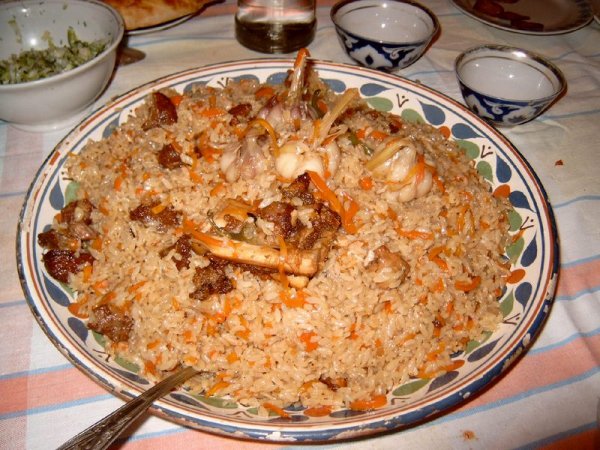
   Amid these demographic and culinary changes, there has been one constant: plov. This hearty mix of rice, spices, carrots and meat has featured in Russian kitchens for generations. These days, the dish is generally identified as Uzbek, but that was not the case until official Soviet mythmakers made it so in the 1950s. After that, plov became the one Central Asian dish widely known in Russia; over the past two decades, it’s stayed put as a much broader array of the region’s cuisine has turned up, plied by everyone from kiosk food vendors to Russia’s most illustrious restaurateur.


plov                                                                                                                        (photo: wikipedia)

   “Every Russian family cooked borscht, plov and shashlik [grilled meat]. But nobody really understood or thought about how borscht is Russian, plov is Uzbek and shashlik is Georgian,” said Evgeny Dyomin, head chef at the historic Uzbekistan restaurant in Moscow.

 
   Many would counter that borscht is in fact Ukrainian, but that only emphasizes the adaptability and hard-to-pin-down roots of many popular dishes. The food historian and critic Anya von Bremzen says plov – known elsewhere as pilaf and pilau – may have originated in Persia, which had immense cultural influence in both Central Asia and the Caucasus. And plov’s appeal is largely explained by the simplicity and relative cheapness of its ingredients.
 

   “You could always find rice. I don’t remember any massive shortages of rice. You didn’t need a lot of meat, just a fistful to flavor. You could always find carrots,” said von Bremzen, author of "Mastering the Art of Soviet Cooking: A Memoir of Food and Longing."
 
   Plov’s popularity was cemented by the official Soviet culinary bible, “The Book of Tasty and Healthy Food.” However, the 1939 edition identifies plov as a dish from the Caucasus. The word “Uzbek” does not feature once in the book, which includes recipes for plov with lamb, with fish, with mushrooms, and with pumpkin and dried fruit. The volume notes that Azerbaijani cuisine includes 30 types of plov and offers a recipe for sweet plov from Guria, in western Georgia. In 1945, Stalin, a native Georgian, served quail plov to Churchill and Roosevelt at Yalta.
 
By the 1952 edition, a recipe for “Uzbek plov” comes just after “Georgian plov”—part of a “politicized” process in which the dish "became" Uzbek, according to Von Bremzen: “The whole Soviet policy of promoting cuisines from the [non-Russian] republics and creating this ethnic canon depended on which republic was more popular at that time” in Moscow, she told EurasiaNet.org.
 
   These days, one busy Central Asian restaurant chain, Choihona No. 1 (choihona is Uzbek for “tea house”), taps into people’s longing for the Soviet era—a major trend among Russia’s eateries and food manufacturers. Its name borrows a utilitarian theme from the Soviet period, when Grocery Store No. 34 might have stood across from Pharmacy No. 20. And plov features prominently on the menu.
 
   “It’s like some kind of nostalgia—because in Soviet times things were not all bad,” explained Timur Lansky, the founder of the chain, which has 40 restaurants in Moscow.
 
   Lansky, who got his start in Moscow’s nightclub scene in the infamously depraved early 1990s, calls Russians’ love of plov “genetic”: “For 300 years we were like one country: Russia, Mongolia, Uzbekistan—the Golden Horde.”
 
   But Choihona No. 1 has also helped make plov, which can be a time-intensive dish, convenient and cool. The chain has snug couches where diners can smoke hookahs until dawn. Its prazdnichny (“holiday”) plov is a tiny bit sweet and topped with juicy chunks of lamb. Attentive waiters keep the tea and cocktails flowing, delivery is available 24 hours a day, and prices fall within reach of Moscow’s teeming middle class.
 
   At the highest end of the market is the restaurant simply called Uzbekistan, opened by the Uzbek Soviet Socialist Republic’s Ministry of Commerce in 1951, just off Moscow’s downtown boulevard ring. Chef Zifa Saitbattalova, who has worked there since 1985, recalls lines around the block and people paying others to stand in line for them. “The restaurant had separate deliveries of food from Uzbekistan. Food that you couldn’t find in stores you could find here,” Saitbattalova said.
 
   Restaurant magnate Arkady Novikov now owns Uzbekistan. After a 1997 renovation, the upscale restaurant’s ornate interior looks like an orientalist’s fantasy come true. The mother-of-pearl-inlaid furniture hails from Damascus, the paneled doors from Morocco. At lunchtime, a hostess dressed like a belly dancer seats burly, besuited men in secluded nooks. The prices are steep: A portion of plov costs 860 rubles (currently about $14) as compared with 395 rubles at Chaihona No. 1. But the plov – served with fresh tomatoes and roasted garlic – ranks among the city’s best, as does the baklava.
 
   Even in the more affordable of Moscow’s many Central Asian eateries, the clientele seems largely Slavic. “I don't think the popularity of our cuisine was influenced by the torrent of migrants. They don’t influence locals. It is that our cuisine is cheap and healthy,” said Rushan Arslanov, manager of a popular Tajik restaurant, Khayam, which serves a memorable and reasonably priced shashlik lunch, and offers karaoke until 5:30 each morning.
 
     For a more family-friendly atmosphere, Brichmulla in eastern Moscow cooks its meat pastries in gas-fired clay ovens in an open kitchen. Waiters wearing long chapan robes, à la Hamid Karzai, scurry about serving some of the best shorpo lamb soup in town.
 
   That said, cafes in the bazaars on Moscow’s outskirts do cater mostly to Central Asian migrant workers. The menus are simpler and the food cheaper, but often just as good as the pricier, full-service restaurants.
 
   Ironically, much of the Central Asian food in Moscow tastes better than what one finds in the Fergana Valley, where the meat is often dry or gamey and the greasy rice can leave pools of cottonseed oil in the bottom of the bowl. Cafés often offer just one dish, like shorpo, which some travelers associate with a chunk of rancid fat in cloudy water. Excellent food is available, especially in private homes, but dining out can be disappointing.
 
   At Brichmulla, a Russian who was raised in Tashkent laughs after he bites into a steaming samsa: “You come to Moscow and the Uzbek food is better than it is in Uzbekistan.”

David Trilling -- Eurasianet.org