Wenn deutsche Reporter über Ereignisse und Probleme in Entwicklungsländern berichten, zeigen sie oft eine gewisse Scheu, den Ursachen nachzuspüren.

    Deutlich zeigte sich das bei zwei Reportagen der Süddeutschen Zeitung. "Vor uns die Sintflut" (22/4/15)  hiess ein Bericht des Korrespondenten Arne Perras, der einfühlsam die Probleme Bangladeschs schilderte: die Armut, den steigenden Meeresspiegel dank Klimawandel, das Eindringen des Meeres in das Delta, den sinkenden Süsswasserzufluss wegen Bauten am Oberlauf von Ganges und Brahmaputra, das versalzende Land und die verzweifelte Gegenwehr der Menschen, ihren Kampf um den Lebensunterhalt.  Ein anrührender, guter Bericht.

   Was fehlte, war eine Erwähnung dessen, was die Bengalen selbst zu ihren Problemen beitragen. Ein Hinweis, dass sich die Bevölkerung Bangladeschs trotz der seit Jahrzehnten bekannten Problematik höchster Dichte auf wenig urbarem Land weiter vermehrt, fehlt.  Bei derzeit 170 Millionen Einwohnern ist weiteres Bevölkerungswachstum unvermeidlich, eine dramatischere Gefahr für Wohlergehen und Überleben der Menschenmassen als der steigende Meeresspiegel.  Trotz der seit Jahrzehnten dramatisch gesunkenen Fruchtbarkeit nimmt die Bevölkerung  wegen der extrem jungen Altersstruktur weiterhin Jahr um Jahr um über 2 Millionen zu.

   Kein  Wunder, dass Armut die Menschen -- vor allem die Frauen -- in die Maquiladoras treibt, die berüchtigten Textilfabriken, die dem Land einen kleinen Wirtschaftsboom gebracht haben. Auswanderung kann ein wichtiges Ventil für den Überdruck sein. Aber wer will schon junge Bangladeschis? Im vorwiegend hinduistischen Indien, das Bangladesch umklammert, sind die muslimischen Bangladeschi wenig willkommen.  Auf den traditionellen Arbeitsmärkten im Nahen Osten und in Südostasien sind die 2-3 Millionen Gastarbeiter aus Bangladesch inzwischen starker Konkurrenz aus anderen Ländern ausgesetzt. In Europa ist neben Grossbritannien neuerdings Italien ein Gastland: in Rom bilden junge Männer aus Bangladesch inzwischen eine der stärksten Minderheiten. Laufend kommen weitere Jünglinge dazu, viele mit Booten übers Mittelmeer. Haben sie eine Chance, als Asylbewerber anerkannt zu werden? Wohl kaum. Ein wirkliches Ventil für den Bevölkerungsdruck kann Europa nicht bieten.

   Zwei Tage später erschien in der Süddeutschen ein Bericht des Korrespondenten Tobias Zick  "Vergeltung" (24/4/15) über die Situation der Somalis in Kenia und das Flüchtlingslager Dadaab, der Heimstätte von 350.000 Somalis. Zwei von drei Somalia-Flüchtlingen in Kenia leben in diesem angeblich grössten Flüchtlingslager der Welt.  Als Reaktion auf das Blutbad somalischer Attentäter mit 144 toten Schülern in Garissa Anfang April fordert die Regierung nun den Hochkommissar der UN für Flüchtlinge auf, Dadaab binnen weniger Monate zu räumen. Täte er das nicht, dann würde die Regierung selbst die Räumung durchführen und die Flüchtlinge nach Somalia zurückschicken. Wie der Korrespondent berichtet. löste die Ankündigung der Regierung heftige Proteste der Hilfsorganisationen aus. Angeblich verstosse die Massnahme gegen internationales Recht, das Kenia akzeptiert habe. Der Korrespondent meint, Dadaab ähnele inzwischen mehr einer Grosstadt als dem Zeltlager, das es -- wie ein Foto zeigt -- ursprünglich war. Deswegen sei es garnicht möglich, Dahaab zu räumen.

   Warum stösst die kenianische Regierung so brutale Drohungen aus? Um das zu verstehen, muss man ein wenig zurückblättern in der Geschichte. Die somalische Minderheit, die im wüstenartigen Nordosten Kenias lebt, war im Rest des Landes nie beliebt. Das somalische Gebiet war nie sicher. Räuberbanden, shifta genannt, zwangen Reisende und die lokale Bevölkerung zu Vorsichtsmassnahmen. In den Augen der meisten Kenianer waren Somalis shifta und umgekehrt. Der Staat glänzte hauptsächlich durch Abwesenheit.

   Kenia hat viele Stämme, und einige haben noch recht elementare Sitten. Damit konnte die einstige britische Kolonie gut leben. Das änderte sich, als 1991 nach dem Tod des Diktators Siad Barre Somalia im Chaos versank und tausende von Flüchtlingen über die Grenze kamen. In Dadaab fanden Jene Zuflucht, die keine Verwandten und Freunde in  anderen Orten Kenias hatten, die ihnen Unterschlupf bieten konnten. Die Zahl der ungeliebten Somalis -- einheimische und fremde -- wuchs rasch an. Dazu gesellte ich etwas anderes: die Demografie. Die Somalis sind zusammen mit den Einwohnern von Niger die fruchtbarste Bevölkerung der Welt mit durchschnittlich sieben Kindern je Frau. Die Kenianer, auch recht fortpflanzungsfreudig, liegen bei etwas über 4 Kindern je Frau. Das bedeutet, dass der somalische Bevölkerungsteil durch Einwanderung und hohe Fruchtbarkeit viel schneller wächst als die restliche Bevölkerung Kenias. Ein Umstand, der in Nairobi wenig Freude auslöst.

   Aber warum jetzt plötzlich Dadaab auflösen? Man mag vermuten, dass das Blutbad von Garissa nur den Anlass lieferte, eine lange erwünschte Massnahme gegen alle Widerstände umzusetzen Das, was mit Flüchtlingslagern geschieht, wenn man sie nicht rechtzeitig auflöst, illustriert die Geschichte der Palästinenser.  Die Sonderorganisation der UN für die Palästina-Flüchtlinge UNRWA schreibt:  "When the Agency began operations in 1950, it was responding to the needs of about 750,000 Palestine refugees. Today, some 5 million Palestine refugees are eligible for UNRWA services."  Seit 1950 haben Millionen Palästinenser, die Tüchtigsten und Glücklichsten,  die Lager verlassen, haben sich selbständig gemacht, sind in die Golfstaaten, nach Amerika und Europa ausgewandert.  Trotz Jahrzehnten dieser weltweiten Diaspora gibt es immer noch die Lager. Sie sind immer noch voll von Menschen, die sich als Flüchtlinge bezeichnen, die der Hilfe bedürfen, über sechzig Jahre nach der Entstehung Israels. Eine schreckliche Tatsache, und ein Ergebnis der hohen Fruchtbarkeit der Palästinenser.

   Niemand sollte sich wundern, wenn die Regierung in Nairobi ein solches Szenario für Dadaab fürchtet. Die Fruchtbarkeit der Somalis ist höher, als die der Palästinenser je war. Ob man Dadaab auflösen darf und kann, ist eine andere Frage, ebenso wie die Frage, ob der wilde Nordosten eigentlich zu Kenia oder zu Somalia gehören sollte. 

Ihsan al-Tawil
   A new study raises questions about current guidelines which generally restrict the consumption of saturated fats and encourage consumption of polyunsaturated fats to prevent heart disease. The research was published today, 18 March, in the journal Annals of Internal Medicine. 

   An international research collaboration led by the University of Cambridge analysed existing cohort studies and randomised trials on coronary risk and fatty acid intake. They showed that current evidence does not support guidelines which restrict the consumption of saturated fats in order to prevent heart disease. The researchers also found insufficient support for guidelines which advocate the high consumption of polyunsaturated fats (such as omega 3 and omega 6) to reduce the risk of coronary disease.

   Furthermore, when specific fatty acid subtypes (such as different types of omega 3) were examined, the effects of the fatty acids on cardiovascular risk varied even within the same broad ‘family’ – questioning the existing dietary guidelines that focus principally on the total amount of fat from saturated or unsaturated rather than the food sources of the fatty acid subtypes.

   Gates Cambridge Scholar Dr Rajiv Chowdhury, the lead author of the research at the University of Cambridge, said: “These are interesting results that potentially stimulate new lines of scientific inquiry and encourage careful reappraisal of our current nutritional guidelines.

   “Cardiovascular disease, in which the principal manifestation is coronary heart disease, remains the single leading cause of death and disability worldwide. In 2008, more than 17 million people died from a cardiovascular cause globally. With so many affected by this illness, it is critical to have appropriate prevention guidelines which are informed by the best available scientific evidence.”

   For the meta-analysis, the researchers analysed data from 72 unique studies with over 600,000 participants from 18 nations. The investigators found that total saturated fatty acid, whether measured in the diet or in the bloodstream as a biomarker, was not associated with coronary disease risk in the observational studies. Similarly, when analysing the studies that involved assessments of the consumption of total monounsaturated fatty acids, long-chain omega-3 and omega-6 polyunsaturated fatty acids, there were no significant associations between consumption and cardiovascular risk.

Interestingly, the investigators found that different subtypes of circulating long-chain omega-3 and omega-6 fatty acids had different associations with coronary risk, with some evidence that circulating levels of eicosapentaenoic and docosahexaenoic acids (two main types of long-chain omega-3 polyunsaturated fatty acids), and arachidonic acid (an omega-6 fat) are each associated with lower coronary risk.

   Similarly, within saturated fatty acid, the researchers found weak positive associations  between circulating palmitic and stearic acids (found largely in palm oil and animal fats, respectively) and cardiovascular disease, whereas circulating margaric acid (a dairy fat)  significantly reduced the risk of cardiovascular disease.

   Additionally, when the authors investigated the effects of omega-3 and omega-6 fatty acid supplementations on reducing coronary disease in the randomised controlled trials, they did not find any significant effects – indicating a lack of benefit from these nutrients.

   Commenting on how these findings relate to the consumption of red meat, Chowdhury added: “Last year, two seminal papers very convincingly showed that the harm observed in red meat for heart disease risk can, in fact, be attributed to another harmful chemical (L-carnitine) abundant in red meat rather than the long-supposed saturated fat. Unless we have more evidence, higher consumption of red meat should still be considered harmful, but it’s just that the saturates may not be the principal explanation, as is traditionally perceived, for the harmful cardiovascular effects of red meat.”

   Professor Jeremy Pearson, Associate Medical Director at the British Heart Foundation, which helped fund the study, said: “This analysis of existing data suggests there isn’t enough evidence to say that a diet rich in polyunsaturated fats but low in saturated fats reduces the risk of cardiovascular disease. But large scale clinical studies are needed, as these researchers recommend, before making a conclusive judgement.

  “Alongside taking any necessary medication, the best way to stay heart healthy is to stop smoking, stay active, and ensure our whole diet is healthy – and this means considering not only the fats in our diet but also our intake of salt, sugar and fruit and vegetables.”

University of Cambridge


L’aumento della disoccupazione non è la sola conseguenza della crisi sul mercato del lavoro italiano. Si aggiunge anche una diminuzione dell’utilizzo della forza lavoro occupata. Ne è un esempio il massiccio ricorso alla cassa integrazione. Ripercussioni anche sulla qualità della domanda di lavoro.


Il lavoro in crisi

   Le conseguenze della crisi economica sul mercato del lavoro italiano non si limitano alla sola contrazione occupazionale e all’aumento del tasso di disoccupazione. Tanto la quota di occupati che quella di disoccupati nascondono una realtà per certi versi ancora più drammatica. Il Rapporto di monitoraggio sul mercato del lavoro 2014,  pubblicato dall’Isfol, mostra come la distruzione di posti di lavoro sia stata accompagnata, negli ultimi anni, da una contrazione anche dell’utilizzo della forza lavoro occupata, sia in termini intensivi che qualitativi.
 

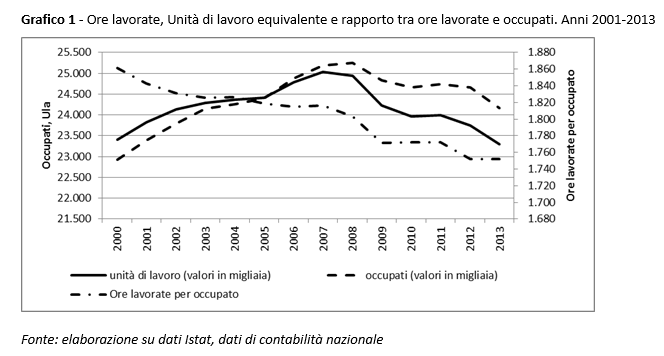
   Le statistiche fornite dall’Istat indicano che dagli anni Duemila in poi il volume di ore lavorate pro capite è andato costantemente diminuendo, pur con una crescita degli occupati totali e delle unità di lavoro equivalente (anche in virtù dell’apertura della legislazione sul mercato del lavoro a forme contrattuali più flessibili). Tra il 2007 e il 2008 le ore lavorate per occupato, però, si contraggono drasticamente, sfiorando prima la soglia delle 1.800 ore a persona, per poi posizionarsi costantemente al di sotto di questo valore.


   Al contempo, l’andamento delle curve relative alle unità di lavoro equivalente e al volume degli occupati segnano anch’esse una repentina inversione di tendenza, ma con la curva delle unità di lavoro equivalenti (che misura il complesso del lavoro utilizzato) che si mantiene al di sotto di quella degli occupati e da questa si allontana progressivamente; segno, appunto, di una riduzione delle ore medie lavorate per individuo.


baronio1


   Sono le conseguenze della crisi economica, che ha portato a una marcata riduzione delle ore di lavoro complessive, ma non a una contrazione dell’occupazione altrettanto forte. Le imprese hanno massicciamente fatto ricorso alle cosiddette politiche di labour hoarding, ovvero quegli interventi tesi a trattenere l’occupazione in eccesso rispetto ai fabbisogni di produzione. Tali interventi si sono esplicitati in primo luogo attraverso il massiccio ricorso al sistema della cassa integrazione guadagni, e della Cig in deroga in particolare, ma anche attraverso una riduzione dell’orario di lavoro, soprattutto tramite il ricorso al part-time involontario.


   In sostanza, esiste oggi una quota di forza lavoro che opera al di sotto delle proprie potenzialità, contribuendo sì a sostenere il tasso di occupazione (i lavoratori in cassa integrazione a zero ore non vengono conteggiati tra i disoccupati), ma nello stesso tempo nascondendo, agli occhi della statistica, una massa di persone potenzialmente annoverabili tra i disoccupati.


Cala la richiesta di lavoro qualificato

   Parallelamente, gli effetti della crisi hanno avuto ripercussioni anche sulla qualità della domanda di lavoro, attraverso un processo di job-reallocation verso profili professionali più bassi. Tra il 2007 e il 2013, in Italia l’occupazione tra i 15 e i 64 anni è diminuita di 852mila unità; ebbene, il valore risulta da un saldo la cui componente negativa è tutta da ricondurre alle professioni maggiormente qualificate che, nei sei anni presi in esame, si sono contratte di 1 milione e 427mila unità, vale a dire del 15,7 per cento rispetto all’inizio del periodo. Al contrario, i lavoratori occupati in professioni di profilo intermedio e non qualificate sono aumentati, rispettivamente, di 216mila e 359mila unità. La riallocazione ha determinato un aumento della quota di occupati overeducated, ovvero lavoratori che si trovano a ricoprire posizioni per le quali, generalmente, si richiede un titolo di studio inferiore a quello posseduto.


baronio2


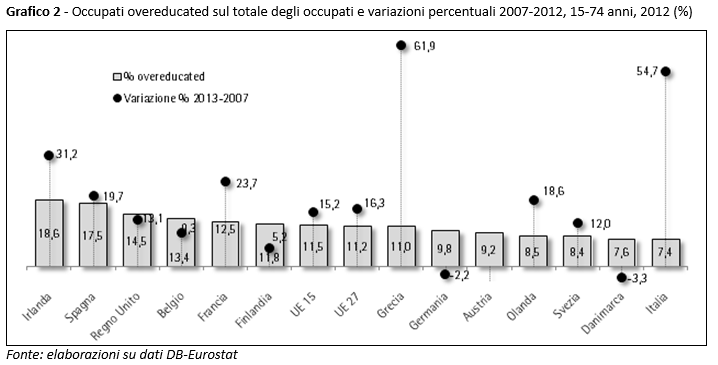
   Nel 2013 il 7,4 per cento degli occupati italiani era sovra-istruito: rispetto alla media europea, il valore risulta relativamente basso. Ma l’Italia, insieme alla Grecia, presenta la variazione assoluta più elevata dal 2007 per questa particolare categoria di occupati, con aumenti molto più consistenti di quelli riscontrati in altri paesi europei e in controtendenza con quanto registrato in Germania e Danimarca, dove la quota di occupati overeducated è diminuita (grafico 2). Al di là delle ragioni che determinano il fenomeno dei lavoratori sovra-istruiti, in parte riconducibile a un non corretto allineamento tra la scelta dei percorsi di istruzione (e la sua qualità) e le esigenze del sistema produttivo, la variazione delinea un arretramento della domanda di lavoro anche in termini di competenze richieste.

   In definitiva, il quadro che emerge evidenzia un clima di grande incertezza, che determina un’occupazione solo parzialmente utilizzata rispetto alle sue potenzialità. Ciò non potrà non avere conseguenze sulle prospettive di crescita futura. Quando la ripresa rimetterà in movimento il mercato del lavoro, gli effetti sull’occupazione saranno, almeno inizialmente, moderati: gli imprenditori, prima di procedere a nuove assunzioni, “riporteranno a regime” il volume di occupazione sotto utilizzato. In secondo luogo, i dati sull’overeducation sembrano mostrare che il sistema produttivo si sta posizionando, almeno in parte, su profili professionali meno qualificati, e quindi con produttività più bassa, di quelli precedenti la crisi economica. Il rischio è che così l’Italia non riesca ad agganciare il treno della ripresa, incapace di competere con paesi che hanno impostato il loro cammino di sviluppo lungo direttrici più coerenti con l’idea di “crescita intelligente” prospettata dalla strategia europea.

Guido Baronio -- laVoce.info 

   Nobody  was surprised with Hillary’s announcement. Now the next question is if the Americans want another Clinton under today’s circumstances for president, despite all the enthusiasm with her announcement.

    There is a lot of talk lately on how Europe with all its problems reminds the same continent in mid-1930s when populists, nationalists, fascist and Nazi movements were rising. A Europe suffering under unemployment, chronic economic recession and poverty. While most are right saying these things about Europe, from this side of the ocean USA also reminds more and more mid-1930s.

   The economic recession is global and even though Obama administration has managed to avoid big hiccups – and all despite Republicans often unethical tripping – the crisis is still here. The Americans might have left Iraq and Afghanistan but new fires seem to rise here and there, all of them demanding US involvement and certain problems with certain nations don’t seem to go away doesn’t matter what diplomacy does.

   But even though serious, everything seems like business as usual. What has changed the last decade is the social behaviour of the Americans or at least it looks that it has changed from this side of the Atlantic. Suddenly old prejudices, discriminations and passions we all thought were left in history, reborn and not only reborn, they seem to divide today’s America deeply.

   Fifteen years ago we all talked about the rising Islamophobia, today we are talking about hate. Hate that doesn’t discriminate - actually it is the only thing that doesn’t discriminate at the moment. The murder of another black man or woman in USA from the police has become news as usual for this side of the Atlantic.

   News about discrimination for race, faith or sexuality have become mainly US news nowadays. While we are talking about disagreements between EU member states – a purely union of independent countries with independent internal, defence and foreign policy - in US it looks like some states of the federation are acting mutiny. There are states in USA that not only disobey the federal laws, ignore the president and the congress all the high court, but they also paraphrase articles of the constitution giving meaning that contradict the founded laws of the USA.

   The opposition party, in this two party democracy – to be honest I never understood how a country with a two party system can accuse another country with one party system as anti-democratic, but this is a different conversation – holds over 45% of the voters; nearly half of the population. This party instead of practicing what an opposition should practice - control of the government, obedience to the laws and the constitution - has turned into an extremist partisan party that has employed every single trick to boycott the federal government. And they do so with a scary fanaticism like they act against occupational army.

   They didn’t only oppose the US government in its negotiations with Iran, they intentionally tried to boycott everything endangering a war with uncontrollable consequences not only for USA but for the whole world. They got involved in the Ukrainian conflict befriending with the most extreme and neo-Nazi elements of the Ukrainian opposition with unknown till now consequences but definitely having a share in the continuing crisis.

   They have created the most prejudice and discriminating laws covering them under religion just like radical preachers do in Afghanistan and Syria. Actually their latest manufacture, “the freedom of religion law” is one of the most discriminating laws in modern history compared only with sharia laws. And the homophobic element is only the peak of the iceberg. The same law can be used against Muslims tomorrow, Jews after and then against anybody left-handed. They have open Pandora’s Box and they don’t know how to close it now.

   And this are just examples. A nation that still doubts if their president had the right to be a president, still considered for some enemy. I was reading the other day an article which called Barack Obama a dictator, his policies Nazi and the Obamacare a Nazi creation. The effect to give health coverage to the poor a Nazi creation? Do these people know what they are talking about? Only the fact that they have the right to say and right things like that isn’t it enough proof that democracy is still there?

   Rand Paul has been GOP’s champion in discriminating and racist comments but the rest of the republican leadership follows very close. It suddenly seems that Sarah Pallin has become the American politics rule and not the exception. And that scares everybody. Because the American president’s influence expands globally.

   From this side of the ocean it looks like the next American president is going to get over a deeply divided country with serious social problems – without including economic problems, unemployment, homeless - and the tendency of some for isolation while they want to expand even by force dominance, however schizophrenic this might sounds. Is Hillary ready for that? Can she unite or she will further divide? Are the Americans ready to stand up and stop this schizophrenic situation? Do the Americans want a president who might stop all that? And do they want Hillary to be the one? And if not, what’s the alternative? Rand Paul?

   It is nearly twenty years since Bill Clinton was president of the USA. The last eight years USA had its first black president and is heading for its first woman president. But is that all the Americans except from their presidents? To be the first black or the first woman? While in the meantime from a champion of human rights they evolve as a society into a global negative example of hate?

Thanos Kalamidas  OVImagazine


Islamic State of Iraq and the Levant (ISIL) militants were given more than 100,000 fake Turkish passports in order to travel to Turkey and then enter Syria to join ISIL, a daily reported on Thursday.

According to a story in the Meydan daily, A.G., an aide of Nurali T., a Uyghur Turk working for ISIL to provide militants with passports worldwide, Nurali T.'s office in İstanbul's Zeytinburnu district functions as an ISIL passport office. Each passport was sold for $200, A.G. told Meydan.

More than 50,000 Uyghur Turks came to Turkey with these fake passports from China via Thailand and Malaysia and entered Syria after staying a day in İstanbul, Meydan reported. A.G. claimed that most of the Uyghurs with fake passports were caught by police in Turkish airports but they were released in Turkey after their passports were seized. “The Uyghurs' release in Turkey is due to a secret [little-known] Turkish law on Uyghur Turks. More than 50,000 Uyghurs joined ISIL through this method,” A.G. added.

Today's Zaman, 9/04/15