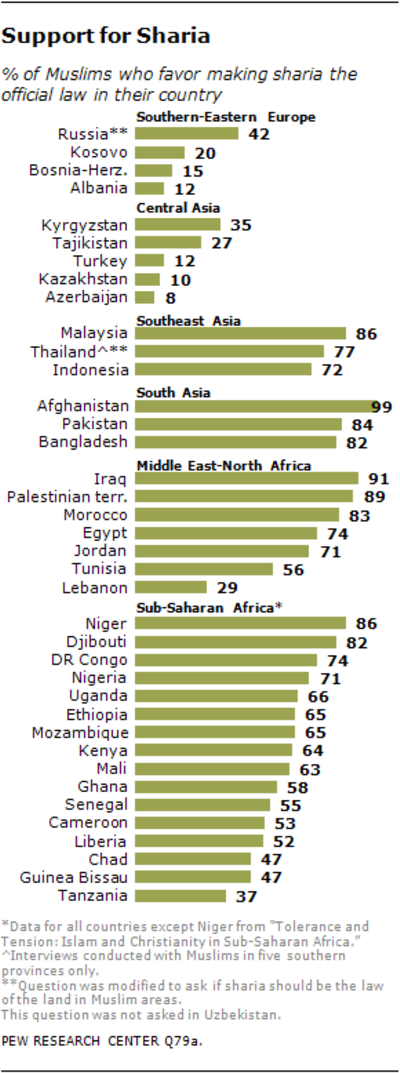
Among its interestung results there is a table showing the level of acceptance of Sharia law among Muslims, by country.
--- ed.
Written on .
Moscow’s primary goal in Syria is not to support its ally Bashar Al-Assad against all challenges but rather to destabilize the situation in the Middle East, undercutting the influence of the West and boosting its own; and to that end, it will be quite prepared to sacrifice the Syrian dictator, according to Belarusian security analysts.
Moscow has chosen to get involved in Syria, the report says, as part of its “multi-goal and many-layered game connected with an increase of its own critical influence on geopolitical processes not only in Syria but also in the Middle East as a whole” – and that region is understood to include Central Asia and Afghanistan as well.
Moscow’s moves “are not connected with unqualified support for Bashar Assad and a war with ISIS toward the latter’s total destruction.” Instead, “Moscow is maintaining contacts with all the sides and forces in the conflict both in Syria itself and also beyond that country’s borders.”
It is “already obvious,” the Belarusian experts say, that “Russia is exerting influence on Bashar Assad with the goal of forcing him” to accept elections, constitutional reform and his eventual exit. When the Russian government has achieved as much as it can from the crisis, they add, “the Kremlin will exit the Syrian crisis in order to destabilize other states.”
The Belarusian security analysts suggest that Russia has three “basic goals” in Syria: destabilization in the region to boost the price of oil, distract the West’s attention from Moscow’s actions in Ukraine and Central Asia and to “legitimate its own right to any action in its ‘sphere of influence,’” and weaken “to the maximum extent possible” the position of the United States.
“The ‘Islamic State’ does not represent a serious threat to Moscow either in the Middle East or in Central Asia,” they argue. Instead, given Moscow’s ties with many in that group, “Moscow’s relations with ‘the caliphate’ must be recognized as extremely varied and hardly hostile.”
The security analysts say that “the course of the Russian military campaign in Syria convincingly shows that the Islamic State is benefiting from the actions of the Russian armed forces if anything more than anyone else in the region, including the regime of Bashar Assad.” Indeed, Moscow needs both the Sunni-Shiite conflict and ISIS itself for its own purposes.
“In the existing situation,” the report says, “Moscow has obtained a unique chance to play on the mutual contradictions of the key players” and not only advance its interests in the Middle East but create problems for the West in what is a “strategically more important” region for Russia, Central Asia.
There Moscow is taking steps to “destabilize the region with the goal of undermining Chinese influence, provoke more active moves by Beijing, and thus destroy mutual trust between the US and China.” And related to that, Moscow is also working to destabilize Afghanistan by promoting “situational” alliances between parts of the Taliban and ISIS.”
“The destabilization of Afghanistan is needed by Moscow also for the formation of a general unstable milieu in the region and for more focused actions toward Tajikistan and Turkmenistan, the significance of which is difficult to overstate in the context of Chinese-American relations.”
While it is taking all these steps, the Belarusian analysts say, Moscow is continuing to put pressure on Mensk to open a Russian base and to ensure that it retains “the military option of solving the Ukrainian issue.” Taken together, such moves “threaten the existence of the current architecture of international security” and open the door to “’a multi-polar cold war.’”
That's the question the German Embassy in Kabul is asking Afghans considering fleeing their home country for a new life in the West. The answer, provided by way of a major media campaign, is that would-be migrants should think twice before they go.
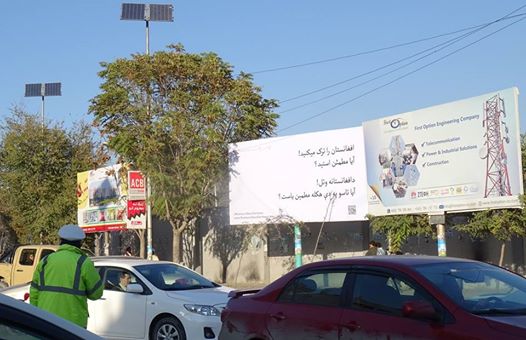
Large billboards have been erected in Dari and Pashto, the two official languages in Afghanistan, in Kabul and other major cities. They direct Afghans to a Facebook page run by the Germany Embassy that seeks to debunk myths about guaranteed jobs and generous payments upon arrival in Germany.
Photo: Geman Embassy/Government Organization
The message, also being delivered by way of the Twitter hashtag #RumoursAboutGermany, is that the tales Afghans are hearing about the good life awaiting them in Germany are too good to be true.
"Do not believe the rumors and false information deliberately spread by human traffickers about the allegedly easy trip and the easy life in Germany," reads one post on Facebook. "Do not risk your lives by trying to flee to Europe. Human traffickers are criminals who are only interested in money. They don’t tell the truth and don’t care about human lives."
هرگز به شایعات و معلومات نادرست که در مورد سفر و زنده گی آسان در آلمان از طرف قاچاقچیان انسان ارایه میگردد باور ننماید. هیچگاه با به خطر انداختن جان خویش به ارپا فرار نکنید.قاچاقچیان انسانها مجرمین اند که فقد به پول فکر میکنند. آ نها هرگز واقعیت را نمیگویند و زنده گی انسان نزد آنها ارزش ندارد.
آلمان ته ده سفراو هلته ده ژوند په باره کښی ده قاچاق برانو په غلطو معلوماتو او قصدی آوازو باور مه کوی. اروپا ته ده تیښتی په لټه کی خپل ژوند له گواښ سره مه مخامخ کوی. قاچاق بران جنایتکاران دی چه موخۀ یی یوازی پیسی دی. هغوی رښتیا نه وایی او ده انسان ده ژوند پروا هم نلری.
آلمان ته ده سفراو هلته ده ژوند په باره کښی ده قاچاق برانو په غلطو معلوماتو او قصدی آوازو باور مه کوی. اروپا ته ده تیښتی په لټه کی خپل ژوند له گواښ سره مه مخامخ کوی. قاچاق بران جنایتکاران دی چه موخۀ یی یوازی پیسی دی. هغوی رښتیا نه وایی او ده انسان ده ژوند پروا هم نلری.
It has been more than four years since the Kenyan Defence Force (KDF) crossed the border into Somalia, and Kenyans are entitled to ask what exactly their troops are still doing there. The official rationale is no longer entirely convincing. The original purpose of the military intervention was to insulate the country from the conflict in Somalia.
‘Kenya has been and remains an island of peace, and we shall not allow criminals from Somalia, which has been fighting for over two decades, to destabilise our peace,’ said George Saitoti, the internal security minister at the time. It is debatable whether that aim has been achieved. Although Operation Linda Nchi (‘Protect the Nation’) curtailed the operations of al-Shabaab, the Islamist militant group has claimed responsibility for dozens of incidents on Kenyan soil in recent years. This includes the high-profile attacks on Westgate Mall and Garissa University.
It didn’t take long for Kenya’s unilateral involvement to be absorbed into (and retrospectively legitimised by) the African Union Mission in Somalia (AMISOM). This gave the KDF a more defined mandate: to root out al-Shabaab and support Somalia’s internationally recognised government based in Mogadishu (known now as the Federal Government of Somalia, or FSG).
This has not been a resounding success either. Although Kenya enjoyed a succession of high-profile victories against al-Shabaab – most notably when it pushed the extremist group out of its de facto headquarters in Kismayo – progress has stalled in recent years. Al-Shabaab remains in control of significant chunks of territory, while the FSG still struggles to assert its authority without the backing of AMISOM troops. Kenyan officials can and do argue that despite the lack of obvious movement, Kenya’s presence in Somalia remains significant: without it, Somalia would revert to chaos and Kenya would be less safe as a result.
They might be right, but a new report written by researcher Ben Rawlence for Journalists for Justice suggests another, less noble explanation. The report examines the illegal trade in sugar and charcoal, and finds that senior KDF figures are involved in both. Even worse, in doing so they are collaborating with al-Shabaab, and providing the militant group with a vital source of revenue.
The United Nations sanction committee prohibited the export of charcoal from Somalia because it was such an important revenue source for al-Shabaab. Sugar is heavily taxed in Kenya, which means there are huge margins to be made on illegal imports.
‘The Kenya Defence Forces, rather than taking the fight to al-Shabaab, are actually in garrison mode, sitting in bases while senior commanders are engaged in corrupt business practices with the Jubaland administration and al-Shabaab,’ said the report.
Here’s how it works, allegedly: ships laden with sugar enter the port of Kismayo, and leave it with a cargo of coal. The KDF levies a US$2 tax on every bag of sugar, while al-Shabaab collects US$1 050 per truck that departs the port. Each truck is taxed again on its way through Somalia by the Jubaland administration (Jubaland is a semi-autonomous region of Somalia), and then again by other KDF elements as it crosses the Kenyan border. For charcoal, the same process operates in reverse.
It’s big business. This illegal trade brings in tens of millions of dollars per year for the KDF elements involved, while al-Shabaab takes home more than US$100 million from charcoal alone. ‘The charcoal trade is not some kind of illicit hobby for KDF officers stationed in Kismayo to earn some pocket money. Together with the import of sugar, it is in fact, the main reason they are there,’ said the report.
The implications are staggering. Not only are Kenyan soldiers profiting from the Somali conflict, they are helping their enemy do the same – the very enemy that funds terrorist attacks on Kenyan soil. It makes a mockery of the entire regional effort to combat al-Shabaab. Further, it raises questions about how much the Kenyan government really knows about what its military is up to. It is damning either way: either the politicians are colluding, or they have no control.
If this report is true, then Kenya’s intervention in Somalia is nothing more than a criminal enterprise, a perfect example of the intersection between organised crime and politics, with an added twist: all its running costs are paid for by the international donors that fund AMISOM.
Naturally, an outraged KDF has been quick to deny the contents of the report. ‘Those releasing the report can say whatever they want. They have said it many times. KDF is not involved in the charcoal or sugar business. Those who allege to have done investigations must appreciate that the Somali coastline is 3 300 kilometres long and that KDF is only deployed on a 150-kilometre stretch. Somali authorities themselves appreciate that there are so many makeshift ports that are not policed,’ said Colonel David Obonyo, a KDF spokesperson.
The credibility of the Kenyan army spokesmen is at an all-time low, however, following a series of other allegations into corrupt practices (most notably the claims that recruiting officers demand bribes from new recruits). Besides, the damage is already done.
A senior source told ISS Today that the report stains not only the image of the KDF, but of the AU itself, raising questions about the AU’s ability to maintain effective command, control and oversight of the troops operating under its banner in Somalia. The source said that if the AU fails to act, there is an immediate risk of AMISOM drifting further out of control and morphing into a de facto criminal syndicate in Somalia.
Peter Aling'o, a senior researcher and the Nairobi office head of the Institute of Security Studies, said that such concerns are valid. ‘Kenya has vowed to stay put in Somalia despite these allegations. This notwithstanding, the allegations of involvement in a sugar and charcoal smuggling racket obviously dents the KDF’s reputation and certainly has a negative impact on the broader AMISOM operations in Somalia. I believe that the information available significantly undermines KDF and AMISOM operations in Somalia,’ he said.
For some Afghan brides, failing the first test of marriage can mean a life of abuse, prison, or even death. (file photo)
Long-standing tradition holds that being a virgin is required for brides in Afghanistan, and they are expected to prove it.
One Afghan woman, speaking with RFE/RL's Radio Free Afghanistan on condition of anonymity, says it is still customary in some areas of the country for in-laws to check for blood stains the morning after a wedding as proof of the bride's virginity.
Even being accused of having sex outside marriage can have dire consequences. Disgraced families have been known to demand that their "damaged" daughter-in-law be exchanged for her sister. Nonvirgins can be imprisoned in Afghanistan for adultery. And there are horrific tales of abuse, or worse.
"In some cases, a bride's ears and nose are cut off," says the Afghan woman. "They are forced into dirty clothes and taken back to her parent’s home. Their heads are shaved. The bride's family is told that she is not a virgin. Other times, a bride is simply killed and her body is returned to her parents."
It's a discussion that is usually taboo in Afghanistan, but a recent spate of chilling public punishments of Afghan women accused of having premarital sex has brought the issue into the open.
In late November, a 26-year-old Afghan woman died of her injuries after being publicly lashed in the central province of Ghor. She had been accused of running away from home.
In October, 19-year-old Rokhsana was stoned to death by Taliban militants in the same province after having been accused of having premarital sex.
And in August, also in Ghor Province, a young man and woman found guilty of having sex outside marriage were lashed publicly.
Family Affair
The woman's own family is often behind the punishment, in some cases shunning the woman or handing her over to authorities for prosecution. But in the worst cases, her own kin can carry out honor killings.
"The existing culture among some families is that a ruined girl is given back to her family," Mariam Zurmati, a commissioner at the Afghan Independent Human Rights Commission, told RFE/RL’s Radio Free Afghanistan recently.
"In order to escape dishonor, that family will offer another of their daughters for marriage," she adds. "In some regions, women are simply killed. In some cases, even after years of marriage, a husband will abuse his wife.”
Marzia, who only goes by one name, says her sister has endured years of abuse at the hands of her husband due to lingering suspicions that she was not a virgin when they married.
"I have a sister who didn’t bleed when she got married. Her husband beats her and she has bruises everywhere."
"I have a sister who didn’t bleed when she got married,” says Marzia, who is from Parwan Province. "Her husband beats her and she has bruises everywhere. Even after years of living together, he still abuses her and tells her she has been tarnished."
Even before the wedding, Afghan brides-to-be can be forcefully subjected to "virginity tests," in which doctors at government clinics test whether a woman's hymen is intact.
Terena Yadgaari, a doctor in Kabul, agrees that virginity tests have no "medical validity," but notes that dozens of the examinations are carried out in government clinics in the capital every year.
So-called moral offenses, including adultery or even running away from home, are not considered crimes according to the Afghan Criminal Code. But hundreds of women and girls have nevertheless been imprisoned after being convicted of "immorality" by courts dominated by religious conservatives.
The Afghan Constitution prescribes that "no law can be contrary to the beliefs and provisions of the sacred religion of Islam," but such rulings are at odds with more secular-minded passages in the constitution.
But in some rural areas, where Taliban militants exert considerable influence, residents often view government bodies as corrupt or unreliable and turn to Taliban courts to settle disputes.
The Taliban courts employ strict interpretations of Shari'a law, which prescribes death, or in other cases publicly flogging, for men or women found guilty of having a relationship outside marriage.